Showing posts with label banyan. Show all posts

Tuesday, October 18, 2016

The scholarly man's tree, Bunjingi style

Bunjingi is a style that flies in the face of conventional popular japanese bonsai aesthetics. The style is very old. This style is a throwback to chinese potted trees. That's that for the history lesson. This post is not really about the style. When I took this cutting I knew that it was going to be bunjingi. It had a long narrow trunk with two very dramatic curves. The problem was how was I going to make this tree look amazing in my eyes.


The tree had started to develop ramification, and it had a basic shape. The tree was looking like it was going to be a chinese type miniature tree. The chinese call their miniature trees penjing. Penjing is not really a style but the chinese word for bonsai. However, the chinese aesthetic value is different from the japanese, so the trees look very unalike.

I was pruning my tree to further develop ramification when my mind's eye saw the bunjingi tree I had been looking for. The best part was that I was going to create this new tree by cutting one branch.


So i took the pruning shears to the main trunk and lopped off the unwanted part. The transformation for now was complete.


I will be starting over with this tree. I have to build ramification and keep shaping the tree, Aesthetically it is a lot closer to done.


The piece I cut off will not go to waste. I potted that piece in bark soil. It will grow roots in a few weeks and I will have the foundations to another future bonsai.


I have said it before, don’t be in a rush to shape, cut, pot, etc your tree. Work on building it up. You will get ideas on what direction to take your tree. cheers.

Wednesday, August 31, 2016

What Ficus Microcarpa has taught me


I have been working with a lot of ficus microcarpa this year. I have learned a few things (and I realized I have many more things to learn).


I have posted many times before on how resilient ficus microcarpa is. Many times I thought I had killed a tree. All the leaves would drop. It would look so sad. I would set them aside to discard later where i would forget about them. Then I would find them some time later with little green buds pushing their way out of the bark. That's not to say that some have not died all the way (The Princess Bride, anybody?). I have bent trunks to amazing curves. I have potted trees in the smallest of pots, I have pruned all but a few short branches and these trees keep coming back. I have seen pictures of abandoned ficus bonsai which have broken free of the pot and have become full size trees.
Epiphytic Ficus Microcarpa


Something I have noticed about FM is that there is a big difference in pruning green branches versus pruning hardened or lignified branches. Knowing what happens can help in bonsai design. When you cut a green branch it will die back to the node just below the cut. You can cut a foot  from a node it will still die back to the first node under the cut. The benefit to this as I have seen is two part. First, as the branch continues to grow it will heal without a scar. Yes, that type of pruning heals fast and if you remove all the dead tissue it will heal smoothly.  Second, I notice that if you cut the bud while the leaf is still small the leaf will pretty much stay the same size. You can get amazingly small leaves like that.


Cutting bigger lignified branches is a different story. A lignified branch is a branch that has become woody. These branches can bud anywhere along the branch. That means that if you cut it short it will bud somewhere in the vicinity of where you wanted it to bud. You may also get multiple buds. That means more branches, more ramification, and more leaf reduction.

New branches started growing after I cut the original branch

There is some differing opinion on what I am going to say next. Please keep in mind that this is a post about ficus microcarpa. If you leave a branch uncut it will thicken faster than  if you prune and let the new branches grow. Here is an example: I let a new branch grow to cover a bald spot on a tree. I did not prune the branch until it got to a thickness close to the other branches. So far so good. Yet, at the same time I have branches that are six month older. These branches i clip because I am trying to develop fine ramification. If these two branches thickened at the same rate I would have incredibly thick branches with exaggerated taper, which is not the case. An uncut branch will thicken faster than branches that are pruned.

Thinner branches on top are older than the bottom branch that has been wired


A great thing about ficus microcarpa is that they are ready to grow aerial roots. All you need is moisture. Here is what I do. I add ground bark to the pot to the height I want aerial roots to grow. Then I water as usual. In as little as a week you will be able to see aerial root buds. Leave the bark (or sphagnum moss, or anything that will keep the trunk moist) on for as long as you want. I have a tree that grew aerial roots very low on the trunk. Now the tree has buttressing roots. I know in cold climates where you keep ficus indoor in special light and humidity grow containers have a high number of aerial roots because the humidity is so high. I have not grown aerial roots from branches yet. I am devising a plan as i write. I will put moss on said branch and will wrap it with mesh. The mesh will help me regulate humidity through spraying. It might be easier to wrap it with plastic, but why make things easier on me?
Aerial roots
Chinese banyan aerial roots


Ficus microcarpa love fertilizer. Ficus microcarpa want to grow. I have seen growth as little as two days after fertilization. I fertilize at the fertilizers manufacturers recommended full strength. The ficus love it. I fertilize every two weeks. However, some times I have fertilized weekly. I have seen amazing growth. I do not fertilize any cutting until I see a few leaves. I figure if the cutting has leaves it has roots. The more roots the more fertilizer it absorbs the faster it grows.
Before, (March 24)

After, (May 23)

I have taken cuttings of varying sizes from epiphytic ficus microcarpa. Some have been the thickness of a pencil and some 4.5 inches in diameter. I would say that 99.1 percent have survived. I have taken cuttings from a FM tree. I have had 60 percent success with those. I always plant cuttings in bark. Bark retains little water yet keeps things moist. Bark has barely any nutrients, so after the cuttings have rooted I put them in composted soil i buy for two dollars American from the big box store. Even the huge cuttings I have taken I have put in bark.
Large cutting


That is all I can think of for now. If I remember anything else I will add an update. Cheers.

Oh yes, more info here: http://www.bonsaihunk.us/

Friday, June 17, 2016

a ficus for you, a ficus for me, a ficus for everybody in this room

Hi everyone, I found an amazing tree this week. Yes, it's another ficus. I love these trees. They are oh so resilient. This one in particular has a very good skeleton. It has a wide base. The base tapers into four branches of varying thickness. I cut the branches down to what I thought would give me good results as far as new branch growth.   Because this is an epiphyte it has many aerial roots growing from the trunk. I see a bright future for this little tree.

future bonsai


I know, I talk about ficuses all the time. To tell you the truth like many other tree species i could have cared less for any ficus. What happened? Well, instead of the usual potted ficus benjamina common to any home or office, I saw on the internet what a ficus could become. I saw twisting trunks, large buttressing aerial roots, and miniaturized leaves. I saw Jaw dropping beauty. I was amazed at the growth rate and sheer will to live.


A ficus is a tropical plant. When I see ficus bonsai i think of hot steamy jungles. I think of Angkor Wat, I think of mayan ruins.  I picture India and monsoon. I can have all of that in a small little pot holding a small little tree.


Ficus are easy finds for me. I work in the middle of the city. However I am surrounded by hundreds of species of trees and plants. From conifers to azaleas. cork oaks to moreton bay ficus. There is a specific pattern as to epiphytic ficus. There is a relationship between Italian stone pine and ficus microcarpa. Ficus microcarpa seem to thrive in the crotch and cracks of stone pine. The crevices and crotches of stone pine hold needle deposits which for the most part lay untampered (the exception is when I snoop around looking for epiphytic ficus). The needles collect dust and dirt, and though we do not receive much rain here in southern California the thick layers of needles hold moisture. The gardeners do turn on the high powered sprinklers who splash the pines from time to time. Birds, i guess eat figs from the many chinese banyan (ficus microcarpa). The birds then deposit their waste when they sit on tree branches. Although we have many trees I only see epiphytes on Italian stone pines, and palm trees. The ratio of pines to palm trees is vastly disproportionate something like 5:1.


Enough about the ficus. I still dislike ficus elastica the so called rubber tree. Although, I have seen one variety with interesting colors and patterns. I have tried to grow ficus religiosa with no success. I have purchased seeds from various sources. I would have bought a young f. religiosa, but the the specimens I have seen are just out of reach as far as price. I also am in search of ficus nerifolia. That ficus also has been out of reach.  I could keep going, but I won’t. Cheers.


Update 07/01

15 days later and little buds are growing out of the cutting. Which means that the cutting has roots. Now that it has roots I will fertilize and being a ficus it will grow exponentially. Yay!


Update August 26:

One month and ten days later the ficus has branches big enough to wire. I still will not prune until the branches are at a desirable thickness. I have noticed that if the branch lignified that it will grow new branches from different places on the branch and not just where a leaf grows.  

chinese banyan cutting pre bonsai


Monday, March 21, 2016

Banyan Style Ficus bonsai from ficus cuttings

Have you ever seen the ficus benjamina trees whose trunks have been braided? After many years the trunks fuse and it literally becomes one tree. This is called inosculation. It happens with trunks, roots, and branches. We can use Inosculation to make a banyan style bonsai.

Banyan trees are trees that start their lives as epiphytes. They grow aerial roots that grow down to the ground. These roots overlap and fuse creating a multilayered trunk. It is a very exotic look. Banyans grow to be immense trees. The branches can grow to be as big as trunks themselves. These branches grow aerial roots that end up supporting these massive branches. I personally love banyan style bonsai.  

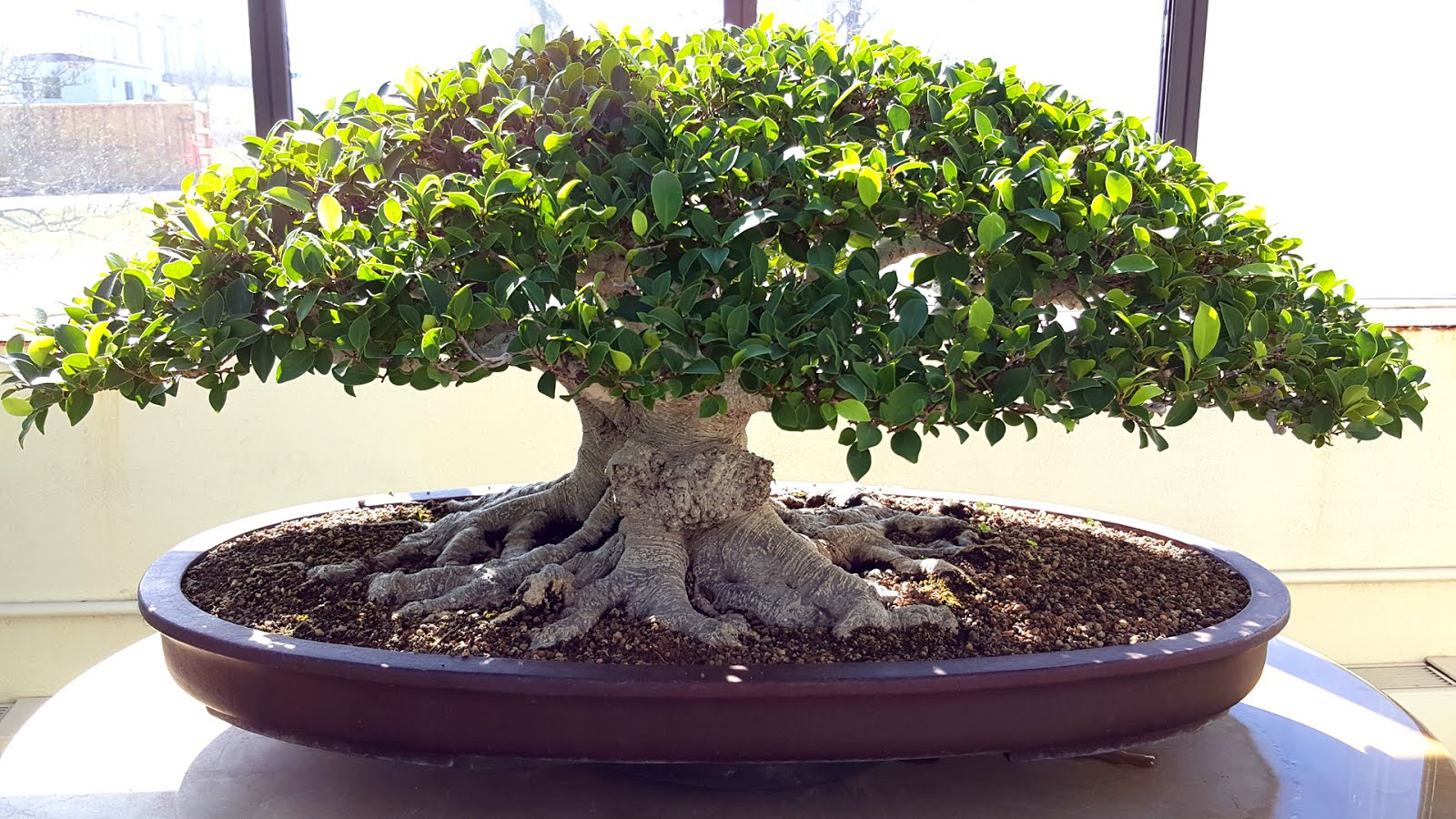
Banyan style tree National Bonsai and Penjing Museum
Aerial roots growing from branches

First, you need rooted ficus cuttings. I used Chinese banyan branches. You should use branches of varying size for an aesthetic effect. You must bind the cuttings and leave them for a year. Yes, one year. Oh, by the way, it is going to take about three years to finish this project. It is a long time but the outcome is great. I used zip ties to bind the trunks. When the zip ties started to make marks I would cut them off and tie new ones on a different place. Before wiring, you have to look at all the branches. Try to figure out what branches will go where.


For the lowest branch, I chose the thickest one. As I wired each consecutive branch I would bend them away from the trunk. There will be time for adjusting them after all the branches are wired. One thing to remember is that the tree will look more pleasing if the thicker branches are under the smaller ones. This should be easy to remember as the thicker ones are usually longer than the thinner ones.


Once you have the lower branches it's time to choose the apex. Take a good look at the remaining branches. I tied a new zip tie to the remaining branches. This will help create a tapering trunk, and it will help place the remaining branches above the lower branches. The branch that I chose as the apex I wired and gave it very modest shape. The rest of the branches I bent away from the trunk. I wanted to give the tree some shape so i trimmed the ends. I also trimmed the branches so that the new branches will grow near the trunk.


When I cut the branch tips I cut just above one of the secondary branches. These secondary branches will become the extension of the primary branch and will create taper.


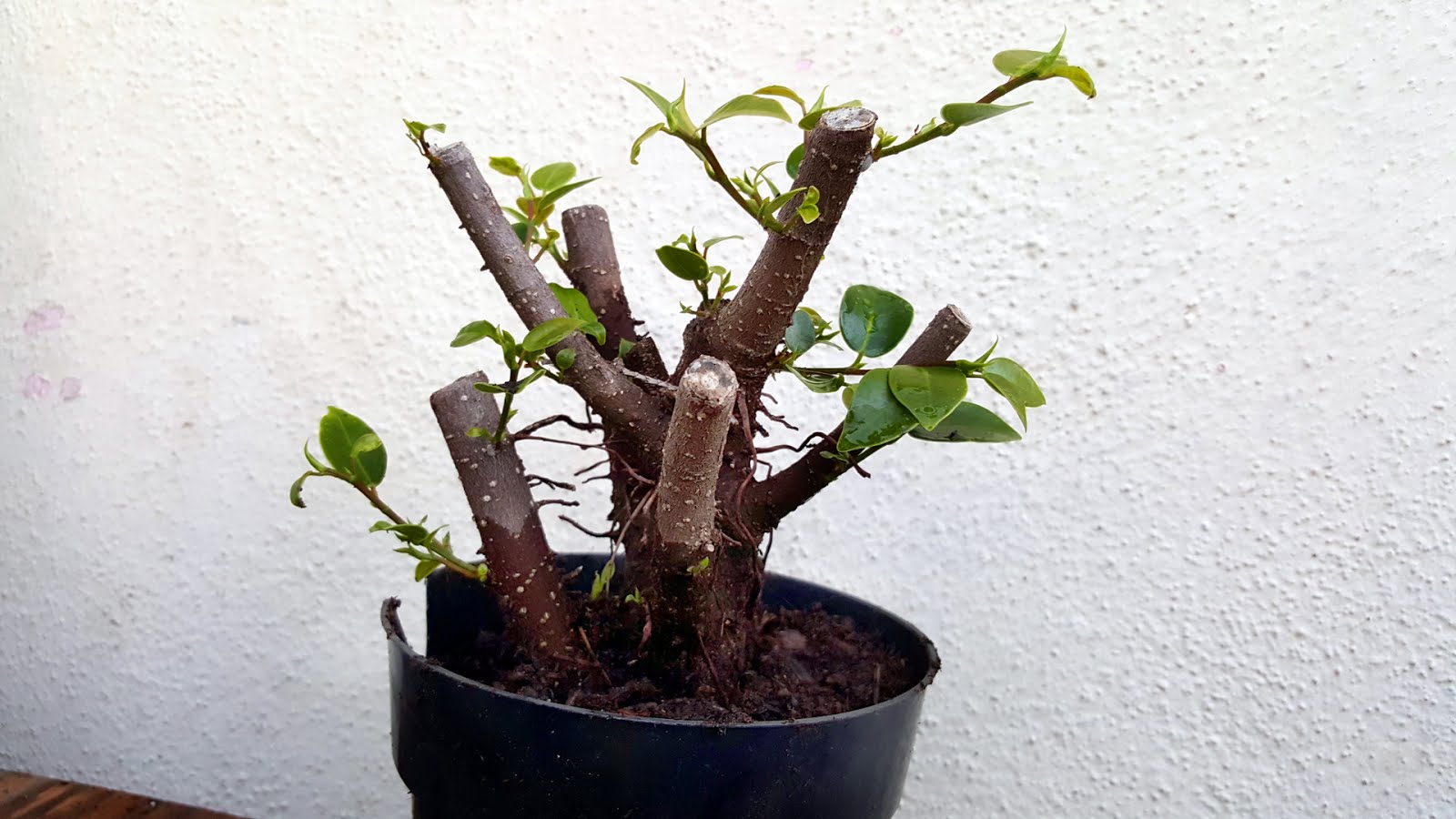
This is what the rough cut looks like. Now it is a question of refining by creating fine ramification.


It will take another year for the fusion to set. As the tree grows the fusion will blend. You will be left with an amazing trunk. Meanwhile, you can treat the banyan like your other tropical bonsai. If you have a west, south, or east facing window you will be able to keep the banyan inside. Cheers.

Update 07/19

The Chinese banyan has grown so much that i had to cut off the ties.  The branches have not fused yet. However, the branches have taken shape. Secondary branches have started to grow. 


 The main branch had the deepest grooves left by the wire. I did not prune this branch at all. That is why the growth was so great.

The growth was so good that the branch managed to pop out a fig. I have never seen that on one of my trees before. 
chinese banyan pre bonsai with fig

I put tow ties on the trunk to secure it. Hopefully, most of the branches start fusing by the end of this year. I rewired some of the branches and put the tree back in its spot.

Update 10/13/2016

A few weeks ago I noticed that the length of the branches was too long for the size of the trunk. So I chopped the tree down to size.

fused chinese banyan


This is the same tree I have been working on this year. Some of the branches have fused. Some other ones not so much. What's interesting is that I started another fused ficus and that tree has completely fused together. The trunks have started growing more branches which I hope will become the secondary branches.

Update 02/04/2017

This is an update on the fusing of ficus microcarpa in general. I have several trees I am fusing. This one seems to be slightly ahead of the curve. I started the fuse in April. The red arrows point the way. click on the pic to see a bigger image.
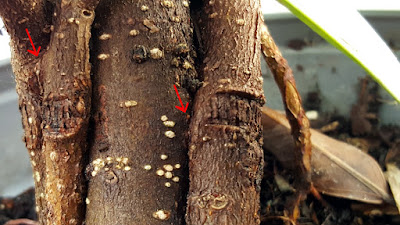
chinese banyan fusing
Fusing ficus microcarpa

Update 02/28/2017

Back to the tree, we have been working on. This is what it is looking like today. I pruned the tree hard. Now it has many fine secondary branches.

work in progress

The tiny little cuttings are starting to fuse. There is a lot of scarring from the zip ties. However, the trunk is small and young. By the end of summer, they will be bu a faint light discoloration. 


It's early February here in LA, that means springtime, means fertilizing will start for the ficus.

April 4, 2016 Update:
Spring is in full swing. It's time to give the tree another haircut.

Before


After


Monday, March 14, 2016

Leaf reduction and its ramification

Leaf size reduction, let's do this. Leaf reduction comes from fine ramification. That's it, this might be my shortest post yet.

Ramification is when a branch grows, then a secondary branch grows on that, then another branch grow on the secondary branch. A key point is that the growing branch remains smaller than the branch it grew on. The rule is that the finer the branch the finer the leaf size. There are limits to how small the leaf can grow, and not all trees will reduce in leaf size.

Some trees will only grow branches where leaves grow. Some others will grow branches anywhere on trunks and branches. Having said that I have noticed that for some species if I cut the branch short before it is lignified (before the branch becomes woody), the first pair of leaves of the secondary branches will grow very small.

When thever secondary branch gets to a desired thickness prune it shorter than the main branch. Keep doing this with the third and fourth branches. Cut each branch length smaller than the branch it grew from or until you get the desired results. How short should you cut them? Well, People will tell you many things. It depends on what shape your giving the tree, and the branch you are working on. The best thing to do is to do and learn.  

Leaves are solar panels. The tree needs a minimum amount of solar panel surface area to survive. As you reduce the size of the leaves the tree will produce more leaves to compensate. A great example of this is ficus benghalensis. The leaves of this tree are bigger than a human hand. Yet, the size of the leaf can be reduced greatly on a bonsai through ramification.  

Lastly, some people defoliate a tree in the summer. This causes the tree to push out a new flush of leaves out (remember, a tree has a minimum solar panel are requirement). The new leaves grow smaller than the previous set. This is usually done the summer before they exhibit their tree.

Reduced leaf size Chinese elm

This is the same species of tree as in the picture above. The seedling is about three months old and has no ramification. If you notice, the leaves are bigger than the leaves of the bonsai that has branch ramification. Look at the base of the seedlings pot. There are some leaves there that are the same size as the ones on the refined bonsai. I thought that it was interesting to see that. I have a theory that leaves can be reduced to about the same size as the plants first true leaves. Ill have to keep making observations though.

Chinese Elm


Ficus microcarpa at the National Bonsai and Penjing Museum


This was a simplified version of leaf reduction and ramification. The basic principles are there. Cheers.


Saturday, February 20, 2016

Cuttings from epiphytic ficus for bonsai or Ficus the Lazarus tree

Epiphytes are plants that start their lives on top of something that is not the ground. Most commonly they grow on top of other trees. I have seen some grow on cracks in walls and on freeway overpasses. You might be familiar with orchids, bromeliads, and tillandsia all of which are epiphytes. This post will be about Ficus microcarpa, or the Chinese banyan tree.  Fig trees are known the world over as strangler trees. A bird eats a fig, and then poops on a tree. Some seeds germinate. The plants get their nourishment and water from moisture and dirt that collects in the crevices where it grows. They are not parasitic organisms. These plants will slowly grow a root down the tree until it touches the ground. When this happens the epiphytes growth explodes surpassing the growth of the host tree. Eventually the epiphytic Ficus will shade the host tree weakening it. The host tree eventually dies leaving the Ficus.

Here in sunny southern California we do not get a lot of rain. This keeps the epiphytic Ficus from getting to a relatively large size. The exception is this massive palm tree growing in the crotch of this blood tree.

This is not photoshop
My office faces this Italian stone pine. I have worked in my office for thirteen years. The grounds keepers will cut and poison this Ficus every other year. The branches are long and slender from last year’s growth. The trunk however is thick and covered in scars. I do not harvest this Ficus because the plant has wedged itself between the trunks and has an amoeba like shape, and that is no bueno.  

See the pruning shears?
This is my favorite cutting tool for collecting these Ficus.  It’s a Gerber saw, and it works great. Later on you will see how straight this saw cuts.

Great tool
This is the prize of the day. I noticed it last year. It is a Ficus microcarpa var. green mound. The leaves grow oval and dark green. It really is a beautiful tree. I had collected some of its branches last year. They are all doing great. Now that we have hot weather again I decided to collect this tree. Now, I call the Ficus the Lazarus tree because it is very hard to kill. I have had Ficus that I have left for dead, I stopped watering them. After it rains some months later they start sprouting green buds. I collected a ficus that was growing on a sheer granite face. It boggles me as to how it survived on smooth granite. I wonder what it clung on to. I removed it and took it home. All the leaves fell, the branches dried. I put it to the side to discard later and forgot all about it. Months later after a rain storm I saw green buds growing. It was amazing. I was going to throw it away.


Anywho, back to business. This Ficus was growing from the inside of the tree out.  I placed the saw as low as I could. The wood was very soft. The saw cut through with no problem.  I placed the cutting in a container with some water.  Notice the size of the trunk? Even at this size the tree will survive and may probably not lose any of its leaves. What other species of tree can do this? Much respect for the Ficus, Rastafari-Haile Selassie. 


See the smooth straight edge? Thank you Gerber.


This is what the tree looks like outside of the tree. There have been times when with a little pressure the whole tree gives and comes off in one piece. This was not one of those trees. 


This was a second tree harvested. It had great taper and aerial roots. 


So, cutting the tree is half of the job. Now the cuttings have to root so that they can start growing again. To do this I put them in bark. I get the bark used for planting orchids. It makes sense to me as they are both epiphytes. I tried using just water. Using just water is a slow process that results in weak roots. I have used an only perlite medium, but the results are not as good as bark. I place the cutting deep enough so that when I add more bark the tree can stand on its own. Both of the cuttings I collected had aerial roots.  This might encourage roots to grown from the bark as well as from the wound. That is totally fine with me. I love the banyan bonsai look. After topping the pot with bark water thoroughly. One thing I have never been able to do is overwater a Ficus that is in bark medium. I have watered Ficus in bark medium up to three times a day for weeks. There was no negative result. 


This is a tree I collected last year. It was growing on a palm tree. It has many scars from when the grounds keepers tried to kill it. I cut it off and brought it home. I see a lot of promise in this tree. 

See the pruning shears?
Thank you for coming with me on this adventure. I enjoy making these posts. I want to send shout outs to the reader here in the States. Also, to the horticulturalists in Germany and India, thank you for reading my posts. Cheers.

Update May 24, 2016

One of my friends said he likes it when I show before and after pictures. I do too. That was a very good idea. I wanted to show a cutting of a ficus microcarpa with a two and a half inch trunk three months after I appropriated it. 

cutting for bonsai
This is a cutting taken in December, in March it had some new growth

Two months after the picture above was taken there is an explosion of new growth.

Spring growth
I am tempted to cut it back. I want some of the branches to get pretty thick so I won't, for now.

Update:  June 22

This is my longest cutting. it measures above two feet. I cut it a month ago and it is doing great.