Showing posts with label making. Show all posts

Thursday, January 12, 2017

uga, buga, Mugo (the european bush conifer)


Winter is in full swing here in southern California. Where I live the Temperature has dropped below 50 degrees fahrenheit a few times over night. I know, t-shirt weather in many places around the world. I picked up a few conifers this week so that I could start working on something during our two and a half month long winter. I have not had much success with conifers in the past. It could be said that I have outright murdered them.  I have made some progress over the last year however, and now feel bold enough to attempt conifers again.

TI picked up a dwarf mugo that cost around $7.00 in U.S. I had bought one before that was much bigger. I found that the branches were very leggy. The legggy branches made it very difficult to work with.
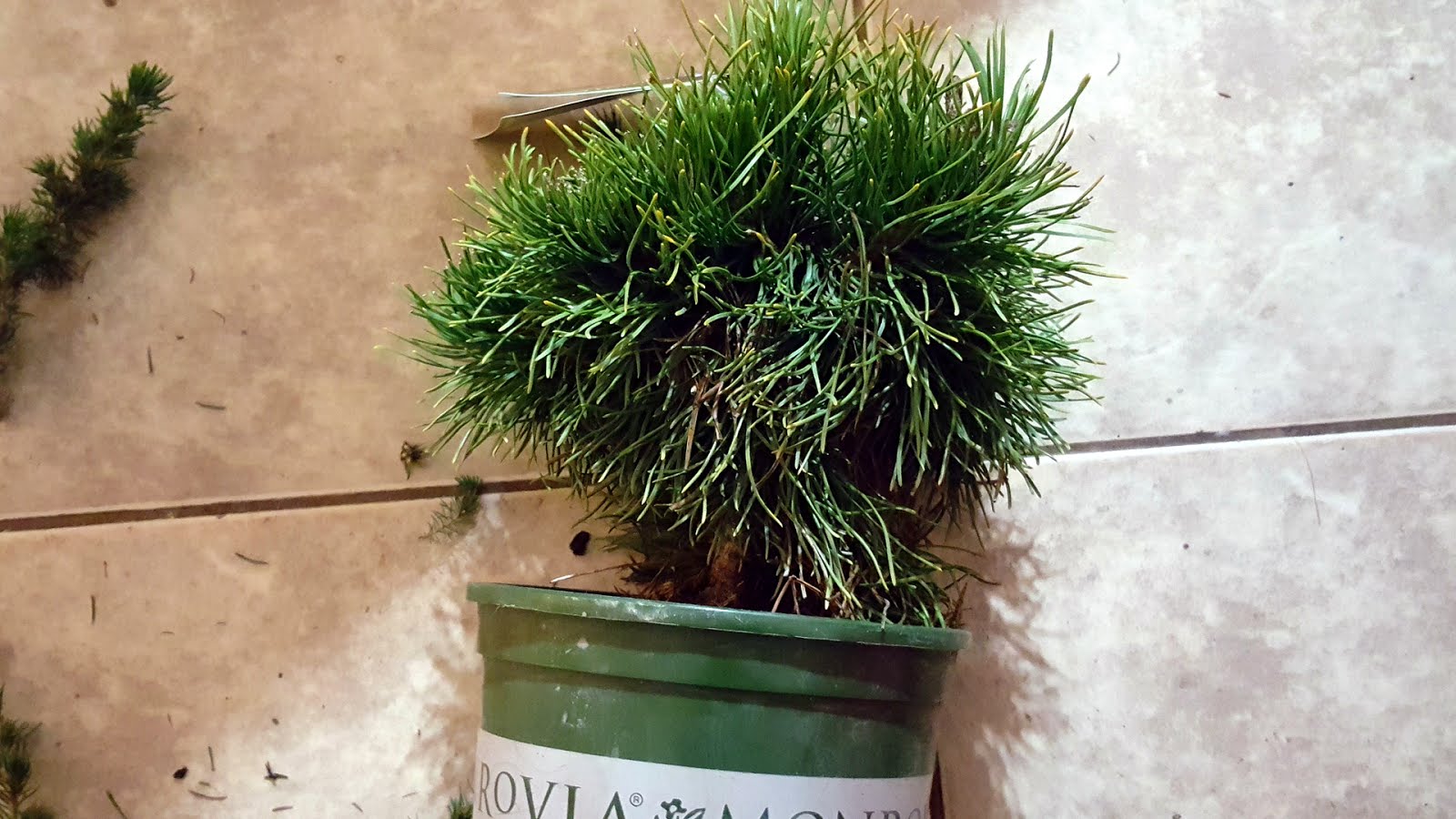


For this tree I started at the easiest place to start. That would be the base of the trunk. The place where the trunk meets the soil. As a general rule there should be no branches there. I keep removing branches as i move up the tree until I feel satisfied with how the trunk looks. With all the foliage removed from the base I can see the tree in a better light. I can make better decisions regarding which branches stay and which branches “got ta go!”


I chopped off all the branches that grew straight down. After that, I chopped off the secondary branches on lateral primary branches. In other words i cut the branches growing up from main branches but not the ones in the tree apex. This thins out the tree quite a bit. It's amazing to see how drastically different a tree looks after each part of the pruning.


After that, I cut branches that are growing out of the same or near the same spot. Sometimes it's obvious which one to cut. Other times it doesn't matter.  You do have to get rid of one for aesthetics. I also cut some of the very small branches that give the tree needle volume but that are not very useful for composition. As a general rule i try to follow the concept of brackets like the kind they use for playoffs but backwards. I follow the main branch, that should split into two branches, those split off into two branches each etc. At this stage in the trees life it is not to important to remove all of the unnecessary branches. I did trim the top a bit to give it some shape.

Brackets like a perfect branch should look like


I still was not feeling right about the tree. so I chopped off the two lowest branches and then it came together in my head. I know some of you may not agree with the last two cuts I made, but I think that this is the foundations for a great bonsai. Did I cut too much? Let me know.


Thursday, April 28, 2016

Bonsai from chain store home improvement centers

Many people put down big box stores or even regular plant nurseries as potential bonsai sources. I say, nay. Are these places the best place to pick up bonsai material? Of course they are not? Then why visit these places? The reason to visit them is because they are more convenient than a bonsai nursery. On a google maps I searched bonsai and got seven listings in the greater Los angeles area. I searched Home Depot and got 12 listings, then I searched Lowes and got 5 more listings. Just by my house there are two Home Depots and 1 Lowes with in a 4 mile radius. There are no bonsai nurseries within that radius, but there are three plant nurseries. Another reason to visit these places is the price. I have bought some trees with amazing trunks for six dollars and change. These trees at a bonsai nursery would easily sell for three to four times as much.

$6.95 for a fosemary with a great trunk
I think it very funny that people who badmouth trees bought at these stores highly prize wild collected trees. These wild collected trees are very difficult trees to work on because they grew however they wanted. It's much easier to work on nursery raised plants than wild plants.

This juniper i found at a regular nursery
There are some drawbacks. First, when we look for plants at a big box store we are looking for the jewell. We want the cream of the crop. It may take time to find a suitable plant. Heck we might not even find anything that week. The second negative is the plant selection. Most of these plants are for landscaping. What that means is that the same plants will be sold in your general area. On the flip side those plants are happy in the climate in which you live.


I have been to bonsai nurseries where they sell lantana for landscaping. These are beautiful 3 gallon plants. I walk to the bonsai section and the same lantana are in a bonsai pot. The new price is eighty five dollars. I am for cutting the middleman out if I can. I need to pinch those pennies.


If you have more time than money than you should look at the big box stores. So, what should you look at when buying plants? That will probably depend on your taste. I will tell you what I look for. First, the plant has to be healthy. There is no point in buying something that will die no matter how great the ramification is. The rest is arbitrary. I love to find plants with great trunks. It takes time to get a thick trunk. If the plant starts with a nice trunk you can invest time on other parts of the tree. Price is important to me. Plants that are around seven dollars are gold. Also, the plant species is important. To me some species are more desirable than others.
A dwarf olive with incredible potential bought at a home improvement center
When choosing a tree always remember that you will be reducing the size that you start with. If you want to end up with a twelve inch bonsai do not buy a thirteen inch tree. For a twelve inch bonsai you might have to start with twenty four inches. Sometimes none of the branches look like they will be helpful, but the trunk looks amazing. For that I lop all the branches off and start fresh. There is no point in keeping something bad just to try to fix it later. That's not to say that you should do that with all trees. If you are unsure of what to do leave it. As new branches and leaves grow you might get a clearer idea of what to do.
I cut all the branches from this pommegranet
Yes you can find material for bonsai at home improvement centers. You will have to look through some plants. I find that specific HIC have the best of one kind of tree. For example one might have great rosemary and another great boxwood. This probably has to do with suppliers in the area. Have a great time hunting for those trees. Cheers.  


Monday, March 21, 2016

Banyan Style Ficus bonsai from ficus cuttings

Have you ever seen the ficus benjamina trees whose trunks have been braided? After many years the trunks fuse and it literally becomes one tree. This is called inosculation. It happens with trunks, roots, and branches. We can use Inosculation to make a banyan style bonsai.

Banyan trees are trees that start their lives as epiphytes. They grow aerial roots that grow down to the ground. These roots overlap and fuse creating a multilayered trunk. It is a very exotic look. Banyans grow to be immense trees. The branches can grow to be as big as trunks themselves. These branches grow aerial roots that end up supporting these massive branches. I personally love banyan style bonsai.  

Banyan style tree National Bonsai and Penjing Museum
Aerial roots growing from branches

First, you need rooted ficus cuttings. I used Chinese banyan branches. You should use branches of varying size for an aesthetic effect. You must bind the cuttings and leave them for a year. Yes, one year. Oh, by the way, it is going to take about three years to finish this project. It is a long time but the outcome is great. I used zip ties to bind the trunks. When the zip ties started to make marks I would cut them off and tie new ones on a different place. Before wiring, you have to look at all the branches. Try to figure out what branches will go where.


For the lowest branch, I chose the thickest one. As I wired each consecutive branch I would bend them away from the trunk. There will be time for adjusting them after all the branches are wired. One thing to remember is that the tree will look more pleasing if the thicker branches are under the smaller ones. This should be easy to remember as the thicker ones are usually longer than the thinner ones.


Once you have the lower branches it's time to choose the apex. Take a good look at the remaining branches. I tied a new zip tie to the remaining branches. This will help create a tapering trunk, and it will help place the remaining branches above the lower branches. The branch that I chose as the apex I wired and gave it very modest shape. The rest of the branches I bent away from the trunk. I wanted to give the tree some shape so i trimmed the ends. I also trimmed the branches so that the new branches will grow near the trunk.


When I cut the branch tips I cut just above one of the secondary branches. These secondary branches will become the extension of the primary branch and will create taper.


This is what the rough cut looks like. Now it is a question of refining by creating fine ramification.


It will take another year for the fusion to set. As the tree grows the fusion will blend. You will be left with an amazing trunk. Meanwhile, you can treat the banyan like your other tropical bonsai. If you have a west, south, or east facing window you will be able to keep the banyan inside. Cheers.

Update 07/19

The Chinese banyan has grown so much that i had to cut off the ties.  The branches have not fused yet. However, the branches have taken shape. Secondary branches have started to grow. 


 The main branch had the deepest grooves left by the wire. I did not prune this branch at all. That is why the growth was so great.

The growth was so good that the branch managed to pop out a fig. I have never seen that on one of my trees before. 
chinese banyan pre bonsai with fig

I put tow ties on the trunk to secure it. Hopefully, most of the branches start fusing by the end of this year. I rewired some of the branches and put the tree back in its spot.

Update 10/13/2016

A few weeks ago I noticed that the length of the branches was too long for the size of the trunk. So I chopped the tree down to size.

fused chinese banyan


This is the same tree I have been working on this year. Some of the branches have fused. Some other ones not so much. What's interesting is that I started another fused ficus and that tree has completely fused together. The trunks have started growing more branches which I hope will become the secondary branches.

Update 02/04/2017

This is an update on the fusing of ficus microcarpa in general. I have several trees I am fusing. This one seems to be slightly ahead of the curve. I started the fuse in April. The red arrows point the way. click on the pic to see a bigger image.

chinese banyan fusing
Fusing ficus microcarpa

Update 02/28/2017

Back to the tree, we have been working on. This is what it is looking like today. I pruned the tree hard. Now it has many fine secondary branches.

work in progress

The tiny little cuttings are starting to fuse. There is a lot of scarring from the zip ties. However, the trunk is small and young. By the end of summer, they will be bu a faint light discoloration. 


It's early February here in LA, that means springtime, means fertilizing will start for the ficus.

April 4, 2016 Update:
Spring is in full swing. It's time to give the tree another haircut.

Before


After


Thursday, March 10, 2016

Great bonsai book, for beginners and everybody else

Bonsai the Art of Growing and Keeping Miniature Trees buy Peter Chan. This is one of the best books for beginners that I have read. This book covers everything from the history of bonsai all the way to preparing for shows and the international bonsai scene. This is not one of those coffee table books with lots of pictures of bonsai but little information. this is an actual book that can teach you fundamentals that other books don't cover.

Peter Chan talks about Horticultural principles like growing trees from seeds, and even Grafting. he tells you how to do it and how difficult it may be. One of the best chapters was on Art Theory. He says that bonsai are living sculptures. he talks about many artistic Concepts that are applied to bonsai. When I would look up YouTube videos in which bonsai professionals would wire branches. I would wonder what their train of thought was. I would wonder how they made their decisions. In this book Peter Chan explains many fundamentals of bonsai design.

What I'm trying to say is that if this book removes all the mystery of how to make a bonsai. Now I'm not saying that he explains every technical or Horticultural detail butt it is a great book for beginners.

One chapter that I have never seen any other book is on how to judge bonsai in a show. He breaks down the different parts of judging and how many points should be awarded. All the mystery is gone.

If I had read this book when I started making bonsai trees I would have avoided much confusion. I had the desire to make Bonsai but not the knowledge and watching YouTube videos was not enough. There are a great many technical books out there for making Bonsai but for the beginner I highly recommend this one. Cheers.

Publisher    Skyhorse Publishing
Publication date    May 6, 2014
Language    English
Product Dimensions    0.5 x 8.2 x 10.5 inches
Shipping Weight    1.9 pounds
Book length    176
ISBN-10    1629141682
ISBN-13    978-1629141688