Showing posts with label cutting. Show all posts

Friday, April 21, 2017

CA Coastal Live Oak Cuttings, or Driving down the one o one


What is your favorite part of spring? For me, it's softwood cuttings. I am by no means a cuttings master,  but I have had my share of experience. I have made cuttings throughout the year regardless of the season and the ripeness of the branch. Most cuttings grew a few did not. The failure was not related to species. Usually, what happened os that I would prune a plant. Then I would try to root the cuttings. Most would make it but some would not. Yet, I would never have a 100 percent failure. I attribute this to the very mild climate.

I want to try California Live Oak softwood cuttings. I think that it will be successful. Here in southern California, we had lots of rain this winter. The Oaks have pushed out lots of new growth. I have access to many Live oaks so I can take a few cuttings from each and try my luck.


These branches are new and have not lignified. The branches are very flexible. The leaves have hardened though. I am going to take as much of the branch as possible. I am not going to cut any branch smaller than five inches.


For the planting medium, I am mixing vermiculite and perlite in a ratio of 1:1. I am using a taller pot so that I can bury the ends of the cuttings about three inches.


This is what the cuttings look like. It has too many leaves for it to survive. The leaves would cause all the cutting to lose too much moisture through perspiration.


I removed the growing tip and all of the leaves except for the top two. The top two just underneath where I cut the tip off.


Just before I put them in the pot I shaved an eighth of an inch from the bottom of the cutting. I did do it twice per cutting on opposite sites. Then I added rooting hormone and planted the cuttings and watered.

California coastal live oak softwood cutting


Even if they fail I'll be able to try in the winter one more time.

I am hoping for the best. I am trailblazing (That means I did not find any info on the web). Updates sure to follow. Cheers.

Update 05/01/2017:

it was a fail.


Friday, March 24, 2017

Juniper cuttings, we were cloning before we knew what cloning was

Have you ever pruned a tree and wish you could do something with the pieces that were cut off? Have you ever wished you can make a clone of a favorite tree? Well, People have been doing exactly that for over a thousand years.


This year I bought my first shimpaku juniper. I was very excited. It was late winter/ early spring (Los Angeles winter). I bought a few shimpaku for a great price. I pruned a couple of trees and I decided to save the cuttings and try to root them.


I have tons of experience rooting ficus. Heck, ficus roots almost by accident. There is no challenge in that. I have rooted rosemary, cotoneaster, and Japanese boxwood. That's the extent of my experience.

The following pictures are of a Hollywood juniper (Juniperus chinensis 'Torulosa'). These junipers grow tall and thick. The point of interest are the branches which grow like the conifers in Vincent Van Gogh’s Starry Night. However, I made shimpaku cuttings earlier that week.

I needed coarse sand. I have looked high and low for coarse sand. I even went to some mountain rivers to collect it. That sand turned out to be decomposed granite which is great but it takes a huge effort to collect. I found a bag of sand used in construction at a big box home improvement place. I sift out the fine sand and keep the large stuff. I think i paid $3.00 U.S. for a 50lb bag (22kg). I would say that about two-thirds of the bag is coarse sand.


sand after sifting
I mixed perlite with that sand. I need the soil to drain quickly and retain some of the moisture. I did not sift the perlite.


Then I mixed peat moss. The ratio was about 1:1:1.


one gallon pot
I grabbed the juniper branch that I collected. I chose some branches that were not too big or not to small.

hollywood juniper cloning

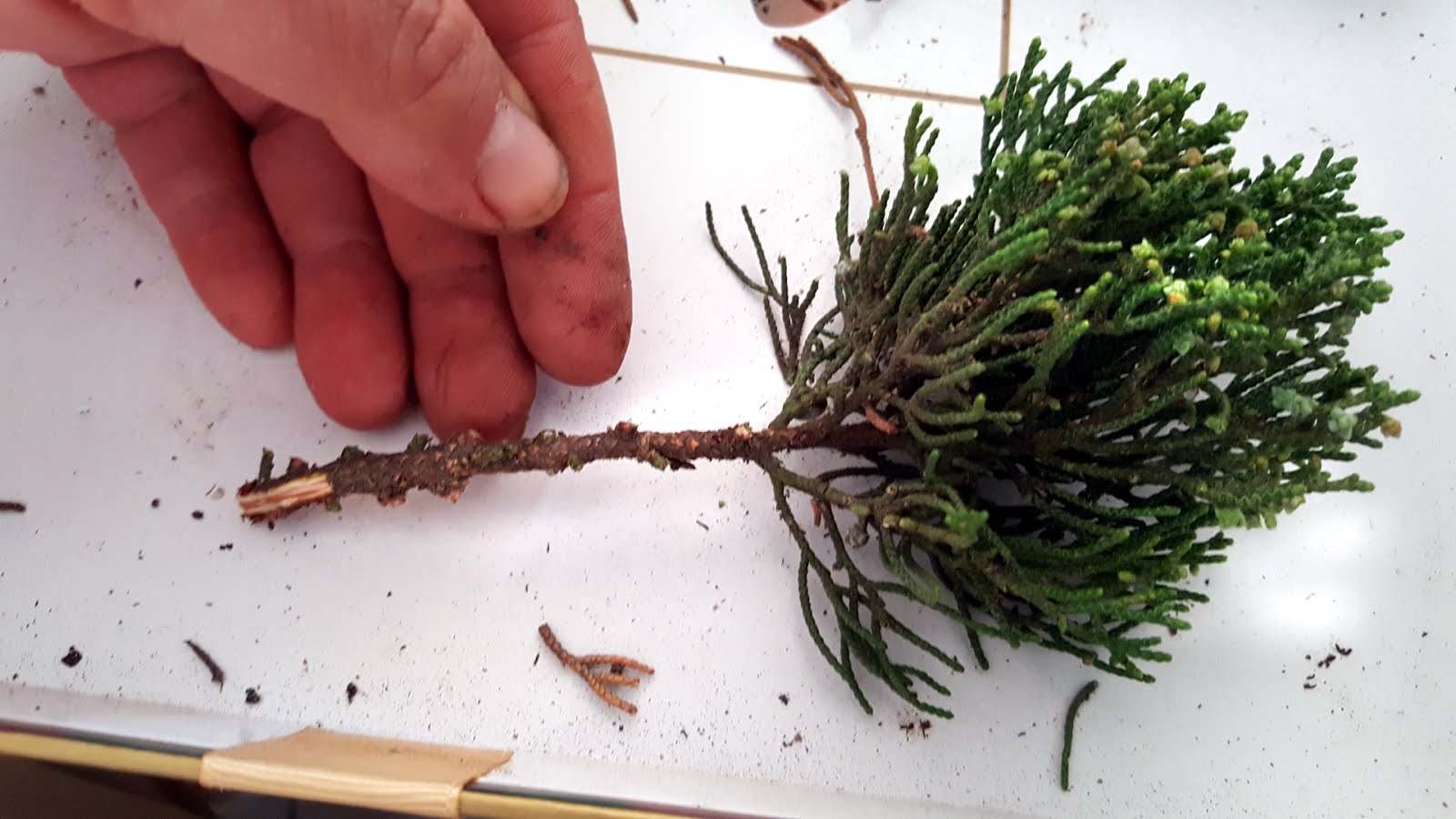
I trimmed all the needles and smaller branches that have been growing near or at the bottom third of the cutting. Then at the bottom, I scrape off a piece of the bark. See the light color tip near where I cut the branch off? I should have scraped twice that amount or even more.

hollywood juniper cutting


That is where the roots are going to grow. I added rooting hormone and placed the branches as far down as the lowest needle. Then I watered the pot trying to thoroughly soak the soil.


Left Hollywood juniper, right shimpaku


That is it. I hope they root because I already have plans for all these baby clones. No, I am not building a clone army. I buy bonsai pots that I like then I make bonsai for them. I have a set of three bonsai pots I think should be for conifers only.


Cheers.

Update 06/05/2016

It's been three months since I potted the juniper cuttings.


Many people are tempted to tug on the cuttings to see if they have rooted. This is not such a good idea. If you tug you may break the roots that have already grown. You just have to wait it out. If the cutting turns brown it has failed. New growth means that the cutting has taken.

New growth means new roots

I noticed that the thicker cuttings had more and longer roots.


Wednesday, August 31, 2016

What Ficus Microcarpa has taught me


I have been working with a lot of ficus microcarpa this year. I have learned a few things (and I realized I have many more things to learn).


I have posted many times before on how resilient ficus microcarpa is. Many times I thought I had killed a tree. All the leaves would drop. It would look so sad. I would set them aside to discard later where i would forget about them. Then I would find them some time later with little green buds pushing their way out of the bark. That's not to say that some have not died all the way (The Princess Bride, anybody?). I have bent trunks to amazing curves. I have potted trees in the smallest of pots, I have pruned all but a few short branches and these trees keep coming back. I have seen pictures of abandoned ficus bonsai which have broken free of the pot and have become full size trees.
Epiphytic Ficus Microcarpa


Something I have noticed about FM is that there is a big difference in pruning green branches versus pruning hardened or lignified branches. Knowing what happens can help in bonsai design. When you cut a green branch it will die back to the node just below the cut. You can cut a foot  from a node it will still die back to the first node under the cut. The benefit to this as I have seen is two part. First, as the branch continues to grow it will heal without a scar. Yes, that type of pruning heals fast and if you remove all the dead tissue it will heal smoothly.  Second, I notice that if you cut the bud while the leaf is still small the leaf will pretty much stay the same size. You can get amazingly small leaves like that.


Cutting bigger lignified branches is a different story. A lignified branch is a branch that has become woody. These branches can bud anywhere along the branch. That means that if you cut it short it will bud somewhere in the vicinity of where you wanted it to bud. You may also get multiple buds. That means more branches, more ramification, and more leaf reduction.

New branches started growing after I cut the original branch

There is some differing opinion on what I am going to say next. Please keep in mind that this is a post about ficus microcarpa. If you leave a branch uncut it will thicken faster than  if you prune and let the new branches grow. Here is an example: I let a new branch grow to cover a bald spot on a tree. I did not prune the branch until it got to a thickness close to the other branches. So far so good. Yet, at the same time I have branches that are six month older. These branches i clip because I am trying to develop fine ramification. If these two branches thickened at the same rate I would have incredibly thick branches with exaggerated taper, which is not the case. An uncut branch will thicken faster than branches that are pruned.

Thinner branches on top are older than the bottom branch that has been wired


A great thing about ficus microcarpa is that they are ready to grow aerial roots. All you need is moisture. Here is what I do. I add ground bark to the pot to the height I want aerial roots to grow. Then I water as usual. In as little as a week you will be able to see aerial root buds. Leave the bark (or sphagnum moss, or anything that will keep the trunk moist) on for as long as you want. I have a tree that grew aerial roots very low on the trunk. Now the tree has buttressing roots. I know in cold climates where you keep ficus indoor in special light and humidity grow containers have a high number of aerial roots because the humidity is so high. I have not grown aerial roots from branches yet. I am devising a plan as i write. I will put moss on said branch and will wrap it with mesh. The mesh will help me regulate humidity through spraying. It might be easier to wrap it with plastic, but why make things easier on me?
Aerial roots
Chinese banyan aerial roots


Ficus microcarpa love fertilizer. Ficus microcarpa want to grow. I have seen growth as little as two days after fertilization. I fertilize at the fertilizers manufacturers recommended full strength. The ficus love it. I fertilize every two weeks. However, some times I have fertilized weekly. I have seen amazing growth. I do not fertilize any cutting until I see a few leaves. I figure if the cutting has leaves it has roots. The more roots the more fertilizer it absorbs the faster it grows.
Before, (March 24)

After, (May 23)

I have taken cuttings of varying sizes from epiphytic ficus microcarpa. Some have been the thickness of a pencil and some 4.5 inches in diameter. I would say that 99.1 percent have survived. I have taken cuttings from a FM tree. I have had 60 percent success with those. I always plant cuttings in bark. Bark retains little water yet keeps things moist. Bark has barely any nutrients, so after the cuttings have rooted I put them in composted soil i buy for two dollars American from the big box store. Even the huge cuttings I have taken I have put in bark.
Large cutting


That is all I can think of for now. If I remember anything else I will add an update. Cheers.

Oh yes, more info here: http://www.bonsaihunk.us/

Friday, August 19, 2016

August repotting of a pre bonsai, the roots are moving to a deluxe apartment in the "sky?"

Here in southern California the heat is on. We just had a heat wave accompanied by a huge forest fire. I live in Los Angeles. This city can get very arid. Since I live close to the Los Angeles International airport I sometimes bump into tourists. One in particular was a very nice man from England. One of his complaints about Los Angeles was that it does not have many green spaces. The reason for this is that los angeles is in fact a desert. We have little rainfall. We have few rivers and streams. If it were not for aqueducts and the great San Francisco earthquake we would have been a small town of little importance.

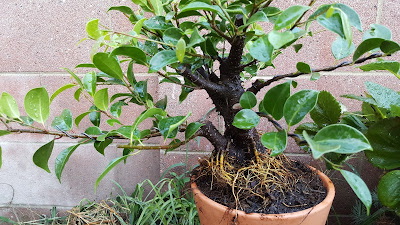
The fact remains that it can get hot in Los Angeles. Heat is wonderful for growing tropical plants. I potted this ficus cutting in a bonsai pot so the roots could start growing. eight months later and the growth rate has been amazing.


I believe that this is the perfect time to pot this tree in a bigger pot. Some people repot conifers and deciduous trees in August. Some tree species go into a dormant phase during August. I am not convinced that tropical trees go into a dormant phase in August. However, it being a ficus it is very resilient, and to tell you the truth I would repot it any time of the year. It's just that I am doing a lot of repotting this week, so I decided to repot this tree as well.


This specific cutting loves to grow aerial roots. In fact, if you look at this picture you can see that some aerial roots have thickened and now look like buttressing roots.  Humidity in Los angeles is midrange to low. When I water the trees i wet the brick wall, I wet all the ground, and I have a tub under some planks to capture the runoff.  All this increases humidity which means more aerial roots.


I am going to try to keep the root ball intact even when it is time to pot in a bonsai pot. I noticed that this is a technique used in conifers.


More space for the roots means more growth. More growth translates to quicker development, or so the story goes. Cheers.


Tuesday, July 19, 2016

Myrtle

Myrtles have beautiful bark, beautiful leaves, and beautiful flowers. Most myrtles come from asia. The popular one in Southern California came from china/ korea.

At the last bonsai meeting it was 2 ½ hours all about Myrtles. It was fantastic. I had not considered this tree for bonsai. Its beauty and fast growth made the myrtle more desirable. I learned that the myrtle is easy to grow from cuttings. As these are abundant trees in my area and they grow many branches from the base of the tree (suckers) it was an easy decision to try my hand at this tree.


I cut these branches friday June 17th. It was about 9:30 in the evening. I had gone to a dinner with my wife and on the way home I picked them up. I could not see where I was cutting it was to dark. I managed to cut some long stems. I placed them in a cup of water. The weather had been hot, so the tips of the branches were a little wilted. The next day in the morning the tips looked a little better.


I placed the cuttings in a bark medium four days after I original cut them. The bark was the kind used for potting orchids. Then we got hit by a heat wave. I thought I was going to lose all the plants. Two of them survived. YAY! It did look like I had lost them all. However, I kept watering the myrtle.  


I am going to go cut some more. Cheers.

Friday, June 17, 2016

a ficus for you, a ficus for me, a ficus for everybody in this room

Hi everyone, I found an amazing tree this week. Yes, it's another ficus. I love these trees. They are oh so resilient. This one in particular has a very good skeleton. It has a wide base. The base tapers into four branches of varying thickness. I cut the branches down to what I thought would give me good results as far as new branch growth.   Because this is an epiphyte it has many aerial roots growing from the trunk. I see a bright future for this little tree.

future bonsai


I know, I talk about ficuses all the time. To tell you the truth like many other tree species i could have cared less for any ficus. What happened? Well, instead of the usual potted ficus benjamina common to any home or office, I saw on the internet what a ficus could become. I saw twisting trunks, large buttressing aerial roots, and miniaturized leaves. I saw Jaw dropping beauty. I was amazed at the growth rate and sheer will to live.


A ficus is a tropical plant. When I see ficus bonsai i think of hot steamy jungles. I think of Angkor Wat, I think of mayan ruins.  I picture India and monsoon. I can have all of that in a small little pot holding a small little tree.


Ficus are easy finds for me. I work in the middle of the city. However I am surrounded by hundreds of species of trees and plants. From conifers to azaleas. cork oaks to moreton bay ficus. There is a specific pattern as to epiphytic ficus. There is a relationship between Italian stone pine and ficus microcarpa. Ficus microcarpa seem to thrive in the crotch and cracks of stone pine. The crevices and crotches of stone pine hold needle deposits which for the most part lay untampered (the exception is when I snoop around looking for epiphytic ficus). The needles collect dust and dirt, and though we do not receive much rain here in southern California the thick layers of needles hold moisture. The gardeners do turn on the high powered sprinklers who splash the pines from time to time. Birds, i guess eat figs from the many chinese banyan (ficus microcarpa). The birds then deposit their waste when they sit on tree branches. Although we have many trees I only see epiphytes on Italian stone pines, and palm trees. The ratio of pines to palm trees is vastly disproportionate something like 5:1.


Enough about the ficus. I still dislike ficus elastica the so called rubber tree. Although, I have seen one variety with interesting colors and patterns. I have tried to grow ficus religiosa with no success. I have purchased seeds from various sources. I would have bought a young f. religiosa, but the the specimens I have seen are just out of reach as far as price. I also am in search of ficus nerifolia. That ficus also has been out of reach.  I could keep going, but I won’t. Cheers.


Update 07/01

15 days later and little buds are growing out of the cutting. Which means that the cutting has roots. Now that it has roots I will fertilize and being a ficus it will grow exponentially. Yay!


Update August 26:

One month and ten days later the ficus has branches big enough to wire. I still will not prune until the branches are at a desirable thickness. I have noticed that if the branch lignified that it will grow new branches from different places on the branch and not just where a leaf grows.  

chinese banyan cutting pre bonsai