Showing posts with label chinese elm. Show all posts

Friday, March 3, 2017

Bonsaiathon at the Huntington Library

Do you like bonsai shows? What if it was at an arboretum? I went to a bonsaiathon at the Huntington Library and let me tell you, It was awesome. We saw trees, pots, rocks. They had demonstrations and booths. It was truly a bonsai lovers paradise.


My favorite bonsai was this California coast live oak Quercus Agrifolia. It had tender new growth. Its trunk was amazing. It was gnarled thick with scars just like a coastal live oak should look like.

quercus agrifolia bonsai

This vendor had a great many incredible pots for sale. He had many shapes, sizes, color, and prices. I was very tempted to purchase some wares.


These pots were going to be auctioned off.


This cascading California juniper Juniperus californica was another favorite. It had two of my favorite things. It was a cascading bonsai and it was a California juniper.

kengai juniperus californica

They had so many types and style of bonsai.


I wanted to go to the demonstrations. They were done by Cesareo Perez, Frank Goya, Fred Miyahara, Kathy Benson, Albert Rivera & Tom Vuong. The problem was that the demonstrations time conflicted with the sale times. Let me tell you, They had trees from $1.00 to $50.00. These $1.00 trees were not dainty little cuttings. They had 2 foot shimpaku juniper. Semi shaped cotoneaster and wild olive trees. There was a very long line to get in the sales are. The tension was definitely palpable. I was in the second group to go in. I picked up 4 shimpaku and 2 olive trees. Total $6.00. I thought about buying more, but 6 trees was more than enough.

These are my first shimpaku ever. I am very excited to work on it. I gave one to my daughter. She wants to make a windswept juniper.


The trees I bought:


I went with my family. We all enjoyed it very much. Cheers.


Thursday, February 16, 2017

One More Time, Root Over Rock with a Twist. a chinese elm

Early in December, I noticed a small Chinese elm growing in my front yard. I thought I’ll let it grow and harvest it next year. With all the rain we have had the ground was soft. The root hairs and all just came up. I  was very pleased. Elated even.


What to do with this gift? I already have Chinese growing in pots from various seeds that I collected. This one decided to be part of my family. Ok, maybe it's not all that. However, I do need a plan for this little tree.


I have a few root over rock tropicals. Making those is like growing moss on a wet rock. It is pretty easy. Why not try something slightly more challenging and make a root over rock deciduous tree?

So here goes this story. I had this rock with a very nice shape. I went to look for my stand by rubber bands. I could not find any. I did have some parafilm I bought for grafting, though. I read that parafilm eventually deteriorates and that it breathes. I thought back to my elementary days in an inner city study hall where they taught me something that seemed contradictory in my ignorant youth. “To be successful you must be a risk taker.”


I placed the roots the way I thought would make for good composition in the future. Then I wrapped the roots as little as possible just enough to hold the roots in place.


This is what the whole thing looked like after:


I decided to pot the rock underneath the soil line. I am using some compost. It is still breaking down. The soil line will slowly drop on its own and expose the the top part of the rock. After I’ll help it a little more.


These are extra pics because I think the tree is very beautiful.


We will see how everything fares out. Cheers.

Sunday, February 5, 2017

My brothers chinese elm keeper

Well, My brother invited me to hi house to see his new baby. While in the back yard I noticed that he had a small chinese elm growing in a planter on the side by a wall. His whole backyard is paved except along the wall. I asked him if he wanted it. It looked peculiar in its place. He told me that it was a weed and that he had hacked it many times.


I did the gracious thing and offered my services to remove the tree (my wife asks me why can’t I be normal?). He was in favor of removing it. I came back a month later and started digging the tree out.

The tree was easy to remove it was in soft soil. It had a curved tap root and two other roots that held the tree in place. The problem was that there was hardly any fine roots by the base of the trunk. All the bigger roots ran under the cement or under the wall. There was nothing to do. I sawed off the tree big roots and the tree came out no problem.


I got it home and noticed that the tree had a very bad reverse taper. Also, my brother had hacked at the tree at the same place over the last year. This forced the new growth to try and become the new leader. So the tree has five or six branches all side by side growing straight up creating a little wall.


When I got the tree home I chopped off the bottom 3 inches because the taper was grotesque. I am hoping that it will grow fine roots from there. I left everything else the same. I didn't even trim the branches down. I know that if the tree lost branches they would lose them at different heights so I was willing to gamble.


It has been raining quite a bit so I have noticed only the tip of the tallest branch has wilted. Not bad at all.

wilted leaves


right side of pic leaves ok, left side leaves dead
Wish me luck. Cheers.

Sunday, January 29, 2017

Dead bonsai, new life

As a general rule you  should never give a bonsai as a gift. You do not unless you know for a fact that the person who will take care of the tree is capable of caring for it.


My mother...lol do you know where this is going? My mother’s boss turned 60 this year. She wanted to give her boss a bonsai for her birthday. My mother swore that she would take care of it as her boss is notorious for killing plants. I said OK and gave her a good looking Chinese elm to present.  

Four months later my mom brought me this:


The amazing thing is that a new growth has popped out from the base of the tree. We’ll see where this goes.


Sunday, January 22, 2017

Los Angeles' has two seasons, Spring and summer

It's been raining in los angeles about every week since Christmas. Let me tell you, I love it. It is going to be a great year for growing plants.


A special feature of los angeles is the amazingly warm winters. I was wondering when I could do some air layering. The recommendation for air layer is to do it when the sap starts to flow. They (who they are, i am not sure) also say that buds are a sign of a tree's sap flowing.

I was looking over the trees in my garden yesterday (january 19th) when I ran across this chinese elm i dug out of my front yard last year.

spring buds

I looked around some more and saw that one of my Japanese Green Maple also had buds on it. That's great because this tree is very tall and needs an air layer bad.


Spring bud

This saturday I am going to air layer like a madman. No plant will be safe. I'll  be cloning trees quicker than Star Wars episode two.

To top it off I will be experimenting with a secret weapon. A synthetic media. Yes I am going star trek up in here.
Im done with the movie references. Cheers.

Monday, March 14, 2016

Leaf reduction and its ramification

Leaf size reduction, let's do this. Leaf reduction comes from fine ramification. That's it, this might be my shortest post yet.

Ramification is when a branch grows, then a secondary branch grows on that, then another branch grow on the secondary branch. A key point is that the growing branch remains smaller than the branch it grew on. The rule is that the finer the branch the finer the leaf size. There are limits to how small the leaf can grow, and not all trees will reduce in leaf size.

Some trees will only grow branches where leaves grow. Some others will grow branches anywhere on trunks and branches. Having said that I have noticed that for some species if I cut the branch short before it is lignified (before the branch becomes woody), the first pair of leaves of the secondary branches will grow very small.

When thever secondary branch gets to a desired thickness prune it shorter than the main branch. Keep doing this with the third and fourth branches. Cut each branch length smaller than the branch it grew from or until you get the desired results. How short should you cut them? Well, People will tell you many things. It depends on what shape your giving the tree, and the branch you are working on. The best thing to do is to do and learn.  

Leaves are solar panels. The tree needs a minimum amount of solar panel surface area to survive. As you reduce the size of the leaves the tree will produce more leaves to compensate. A great example of this is ficus benghalensis. The leaves of this tree are bigger than a human hand. Yet, the size of the leaf can be reduced greatly on a bonsai through ramification.  

Lastly, some people defoliate a tree in the summer. This causes the tree to push out a new flush of leaves out (remember, a tree has a minimum solar panel are requirement). The new leaves grow smaller than the previous set. This is usually done the summer before they exhibit their tree.

Reduced leaf size Chinese elm

This is the same species of tree as in the picture above. The seedling is about three months old and has no ramification. If you notice, the leaves are bigger than the leaves of the bonsai that has branch ramification. Look at the base of the seedlings pot. There are some leaves there that are the same size as the ones on the refined bonsai. I thought that it was interesting to see that. I have a theory that leaves can be reduced to about the same size as the plants first true leaves. Ill have to keep making observations though.

Chinese Elm


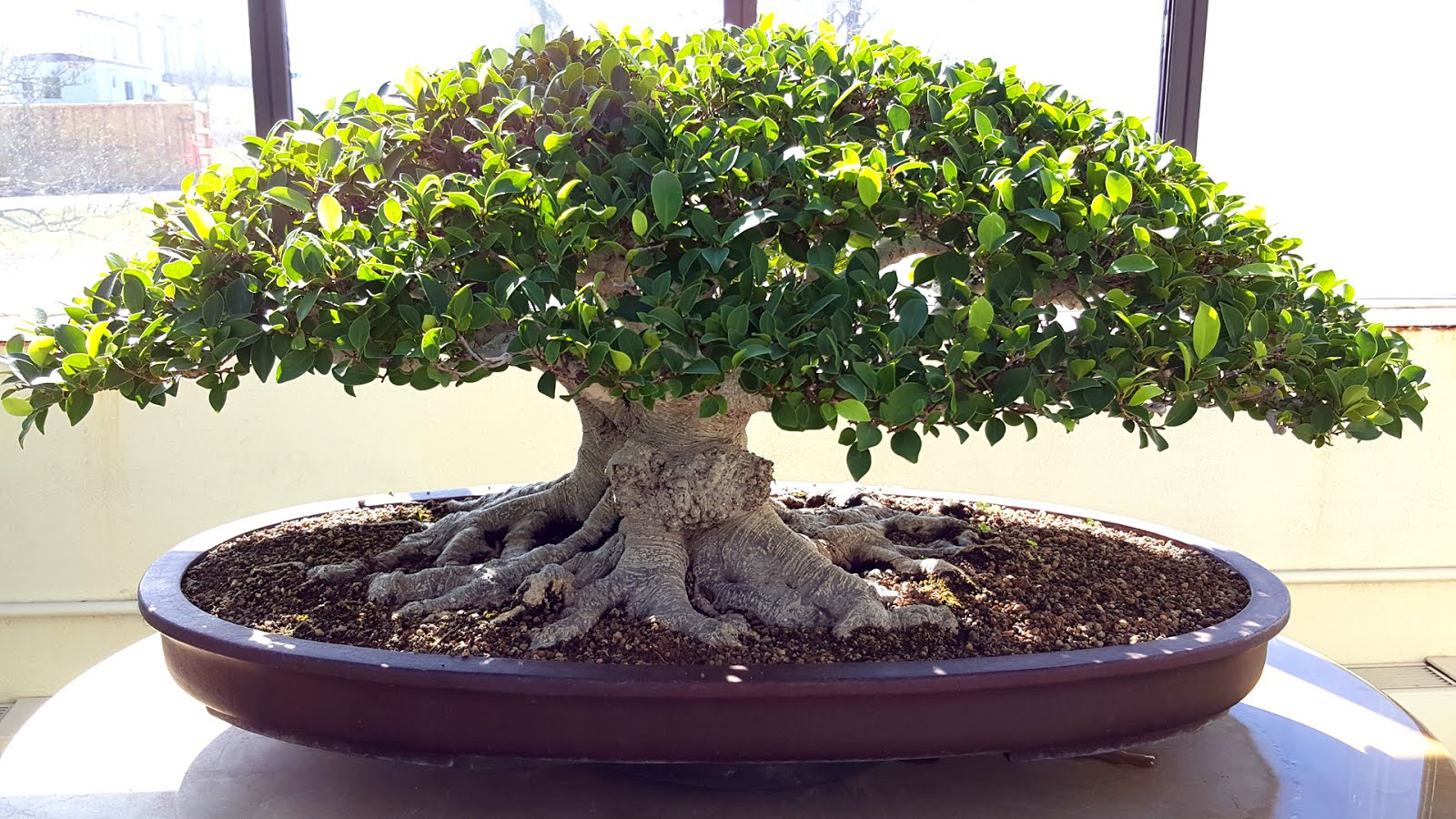
Ficus microcarpa at the National Bonsai and Penjing Museum


This was a simplified version of leaf reduction and ramification. The basic principles are there. Cheers.