Showing posts with label pine. Show all posts

Thursday, January 12, 2017

uga, buga, Mugo (the european bush conifer)


Winter is in full swing here in southern California. Where I live the Temperature has dropped below 50 degrees fahrenheit a few times over night. I know, t-shirt weather in many places around the world. I picked up a few conifers this week so that I could start working on something during our two and a half month long winter. I have not had much success with conifers in the past. It could be said that I have outright murdered them.  I have made some progress over the last year however, and now feel bold enough to attempt conifers again.

TI picked up a dwarf mugo that cost around $7.00 in U.S. I had bought one before that was much bigger. I found that the branches were very leggy. The legggy branches made it very difficult to work with.
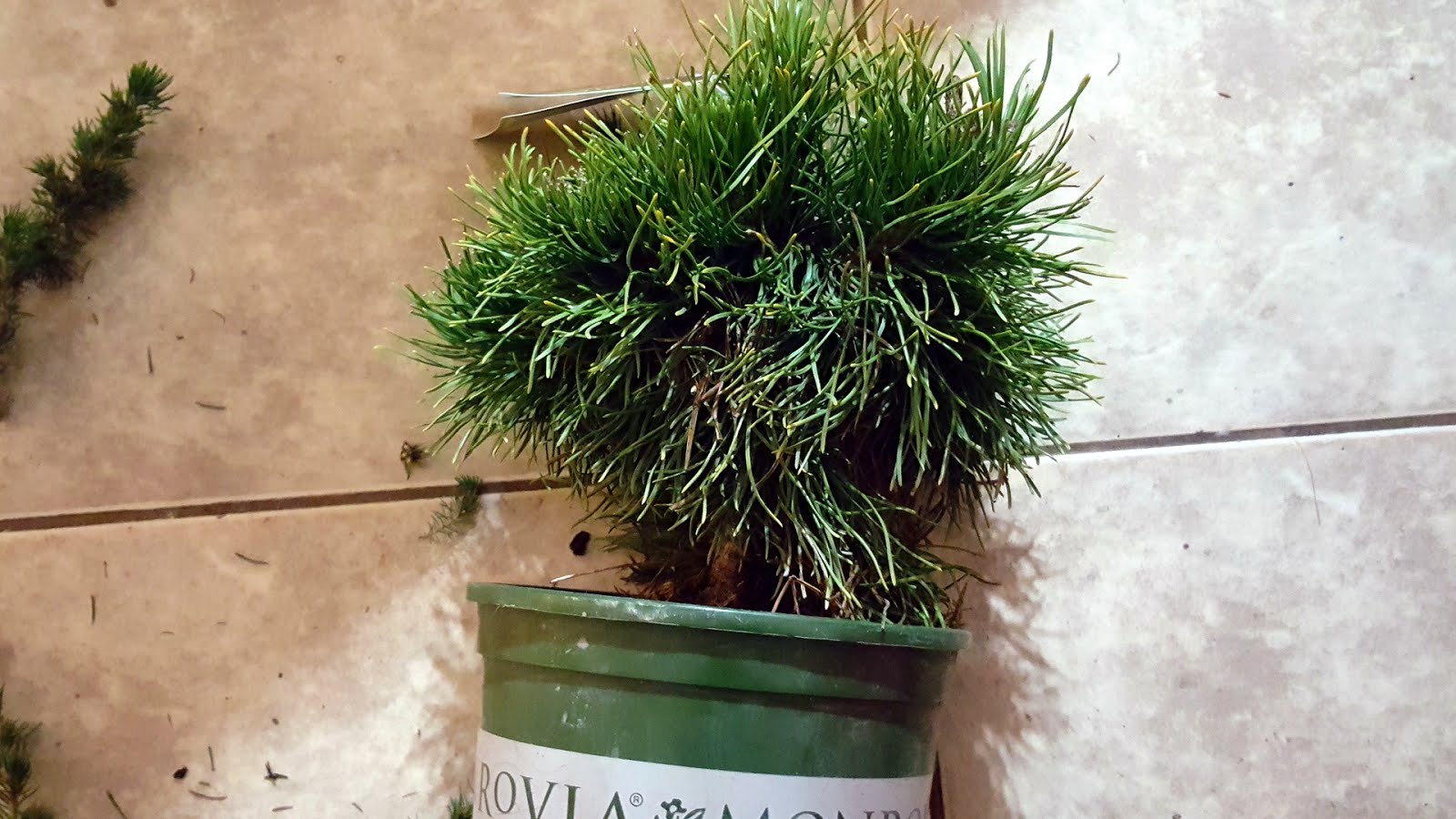


For this tree I started at the easiest place to start. That would be the base of the trunk. The place where the trunk meets the soil. As a general rule there should be no branches there. I keep removing branches as i move up the tree until I feel satisfied with how the trunk looks. With all the foliage removed from the base I can see the tree in a better light. I can make better decisions regarding which branches stay and which branches “got ta go!”


I chopped off all the branches that grew straight down. After that, I chopped off the secondary branches on lateral primary branches. In other words i cut the branches growing up from main branches but not the ones in the tree apex. This thins out the tree quite a bit. It's amazing to see how drastically different a tree looks after each part of the pruning.


After that, I cut branches that are growing out of the same or near the same spot. Sometimes it's obvious which one to cut. Other times it doesn't matter.  You do have to get rid of one for aesthetics. I also cut some of the very small branches that give the tree needle volume but that are not very useful for composition. As a general rule i try to follow the concept of brackets like the kind they use for playoffs but backwards. I follow the main branch, that should split into two branches, those split off into two branches each etc. At this stage in the trees life it is not to important to remove all of the unnecessary branches. I did trim the top a bit to give it some shape.

Brackets like a perfect branch should look like


I still was not feeling right about the tree. so I chopped off the two lowest branches and then it came together in my head. I know some of you may not agree with the last two cuts I made, but I think that this is the foundations for a great bonsai. Did I cut too much? Let me know.


Saturday, February 27, 2016

The bonsai of the national bonsai and penjing museum

This is a picture of the entrance to the National Bonsai and Penjing Museum (NBPM), I forgot to include it in my previous post.

The Bonsai at the NBPM varied in shape and size. Most of the Bonsai would take two people to carry. Some of them measured two and a half feet in height and one was I believe a good four feet tall. The bonsai shown below is a mix of Chinese elm and white Japanese pine. Notice that the silhouette of the whole forest looks like it is a single tree?
A trident maple root over rock style. This tree was about one and a half feet tall.
The following is an amazing example of an upright formal bonsai; it is a white pine. The tree must have been at least 2 feet tall. This is definitely an incredible looking tree with plenty of Japanese sensibility and style.
National Penjing and bonsai museum
 This next bonsai is in the slanting style. The trunk pulls your eyes to the left but that first main branch balances everything by pulling your eyes to the right. This is an incredible example of asymmetrical balance.
National Penjing and bonsai museum
I recommend that you view the following picture in a high-resolution format, you will be able to see the branches curving to the left in greater detail. It looks like nature has pummeled  it and beat it into submission
National Penjing and bonsai museum
 What are Juniper's famous for? Lots of Jin and Shari or deadwood. This tree is great because of the rolling deadwood that goes up the tree.
National Penjing and bonsai museum
 Atlas Cedars are one of the most beautiful kind of Bonsai out there this one is a cascading Bonsai.


 Maple root over rock.
 This Bonsai I was about 4 feet tall it is a red pine.
National Penjing and bonsai museum
 This next tree is in a bunjingi or literati style. Bunjingi means scholarly man's tree, in Japanese. This style is probably one of the oldest and most closely related to Chinese penjing.
 One of the most spectacular bonsai was this bald cypress, it was about 4 feet tall and I can only imagine what it looks like with the green foliage.
National Penjing and bonsai museum

Bonsai

These were some of the highlights from the Chinese pavilion. They are incredible specimens of different species of bonsai and different styles. Of course there were more bonsai there but these are the trees that stood out to me. Many of these trees have been trained for 50 years or more. The key ingredient to great Bonsai is time and patience. Next time on Bonsai misadventure: tropical trees in the NBPM. Cheers.