Showing posts with label how to bonsai. Show all posts

Sunday, April 21, 2019

bonsai 101: what are bonsai seeds?

I want to talk a little bit about bonsai seeds. Sometimes you see these things on eBay these “bonsai seeds”. The fact of the matter is that they are just seeds for whatever species of plant they're selling. Sometimes you see these kits at big-box stores in Hobby Lobby. They sell a bonsai kit which comes with a pot and soil and seed. Guess you're supposed to plant the seed in the potting soil and grow a bonsai tree. but these are just seeds for Japanese Black pine or what not. 


Ponderosa pine

It will take years for the seeds to grow to resemble anything like a bonsai. This is so especially if the plant is kept in a little pot its whole life. Sometimes when I tell people that I make bonsai they tell me about their experience with these bonsai kits. Some of those seeds never sprout. The truth is that for the novice some seeds could be hard to sprout. Some of the seeds need cold stratification, scarification, or warm stratification.

I'm not saying you should not buy them, but understand what you're getting into. They are just regular seeds. The fact of the matter is that a bonsai tree is a plant that somebody cultivates by pruning, wiring, and fertilizing. The seed itself does not a bonsai make.

Brazilian rain tree


So when you buy these bonsai seeds just understand that it's going to take a lot of years for it to develop into anything that might come close to looking like a bonsai.

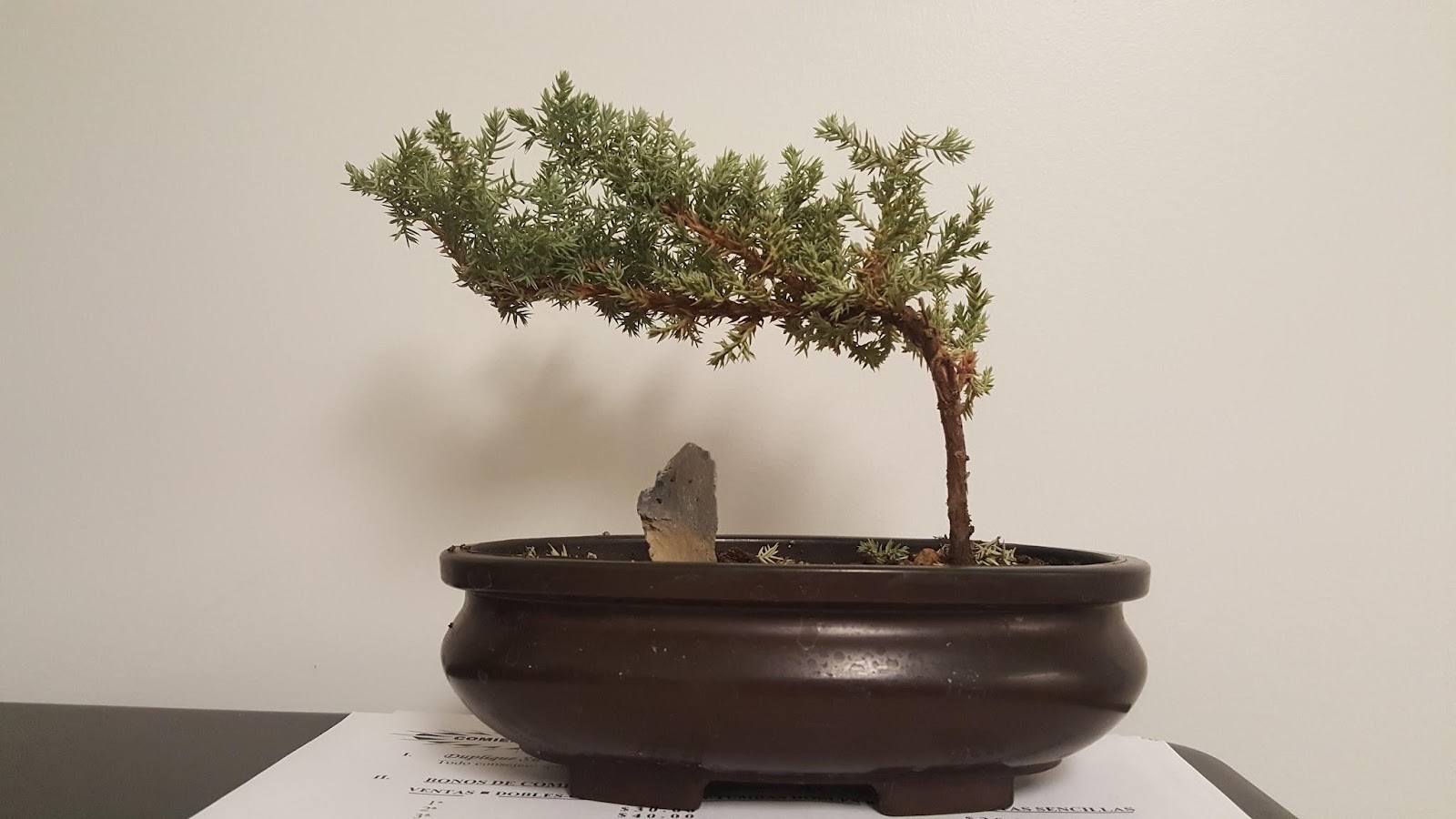
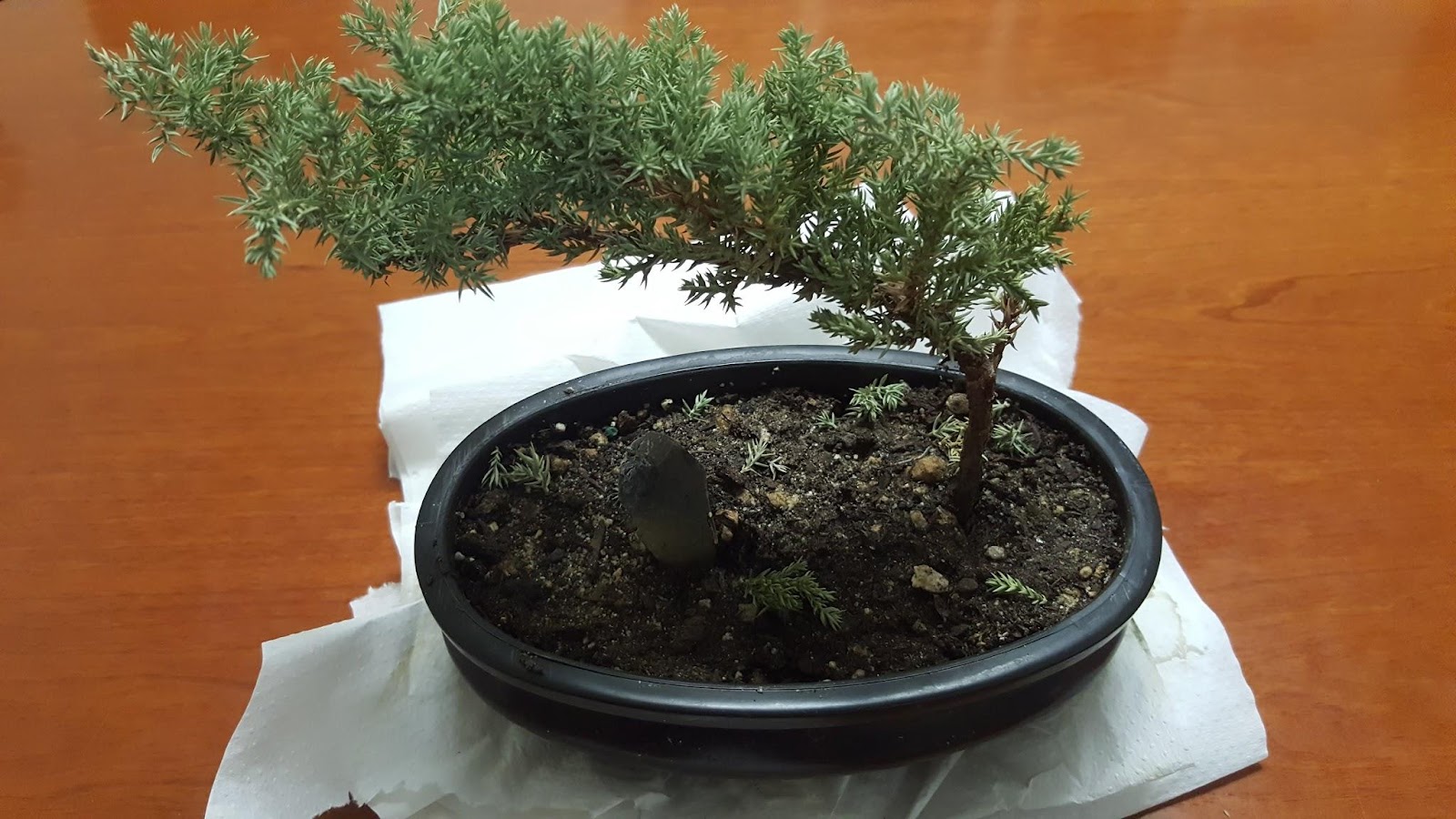
I grow trees from seeds. One of my favorite things to grow is Moreton Bay ficus or ficus macrophylla. These trees get pretty big and very quick. However, it takes a good number of years to get to a size worth showing. I am talking shohin size. Then you have to get the branching out right, the ramification. You can't do that on a young macrophylla until you cut the top tip part right where all the auxin is. When you cut that part it promotes more Branch growth but it slows down the growth of the whole tree over all.

Moreton Bay Ficus


So, I want you guys to know that there are no seeds that grow into a bonsai. A bonsai comes from someone dedicating time and care in developing a plant so that it becomes a bonsai. 

Sunday, April 14, 2019

bad branch location on a bonsai-Ficus

What do you do when you have a massive trunk but the branches are not in the
right place?  If you are talking about a Ficus then make it bald. That's right cut off
all the branches. Do not leave anything.


This sounds like harsh treatment, but desperate times call for desperate measures. One
day I was out collecting Ficus from where I work which happens to have a lot of pine
trees. In those pine trees, little birds deposit ficus seeds and they grow. They can get
pretty big if the landscape people do not get to them. So, one day I found a really big
tree that was as thick as my forearm, I'm not a small guy. The problem was that all the
branches were growing from one side. The side that was facing the tree had no branches. The ramification looked very bad. But the trunk was thick and one
of the hardest things to do because it takes a lot of patience is to thicken a trunk.

I tried growing it out for a while. But had no success because all the smaller branches started growing from all the bad branches. It only had bad branches, to begin with. I didn't want to throw this tree away I had collected it made it into a cutting and it was growing. It would be a
waste to throw this tree away, so I chopped off all the branches.

I had noticed when I cut the branches from another Ficus that they would sprout out
new smaller branches all over. I also noticed that if I left a longer nub of a bad branch
there would be new growth there. That would be bad as those branches would also grow
in a bad spot. So, how could I make branches grow in good spots? The only way was by
removing every branch and not leaving long nubs.

At first, I saw no new growth, and yes I was scared that I might have killed the tree.
That's always in the back of your mind. But one day I saw little buds coming out from the
tippy top of the tree which is great because I don't want branches growing just anywhere
on the tree. They all started to grow where I wanted them to.


Not only were they growing where I wanted them to, but they were growing in large
quantities. So many that I had to cut some of them off because I knew that the tree really didn't need that many branches.

Chinese banyan

I left just enough branches so that they were in a good position, and they would have
room to grow. I wired the lower branches just to give him some shape these are going
to be my longer branches. I'm not going to prune these for a long time. In fact, I'm not going
to prune any branches until some of them get to be as thick as a pencil. The reason
I will not prune them now is that that will slow down the growth.


.As you can see growth is fantastic. I want those branches to grow, grow, grow.

Sunday, April 7, 2019

Aerial roots when you live in a desert.


What are some features that you like on bonsai trees? I love aerial roots on ficus trees. They start out thin, but when they bury themselves in the soil they get fat quick. They add lots of character to the tree.


aerial roots ficus microcarpa bonsai


Aerial roots ficus microcarpa bonsai


To be frank, growing aerial roots was a mystery to me. Sometimes I would see them grow on some of my Ficusses. Then one day after a heat wave killed some of my trees I decided to install a “drip irrigation” system. They actually make sprinklers in 180 degrees, 90, and 45-degree heads. I installed what you might call an overkill of sprinkler heads. I did not want to lose any tree to thirst.

I turned the sprinklers daily. Instead of mostly the soil getting wet the sprinklers would wet everything. I am talking about the leaves, trunks, and all. Also the brick wall, the wood stands, and the ground soil. I was changing the microclimate. Where I keep my trees I have little to no wind. It’s like a little alcove.

After about 4 weeks I noticed that some of my ficusses had a bunch of aerial roots coming from the trunk.

That is how I stumbled upon aerial roots.

I believe that consistently wetting the whole tree helped create aerial roots more than just the higher humidity.

aerial roots, root over rock

I had seen pictures of Scandinavian ficus bonsai. They are kept in grow bags. That is a plastic square bags with artificial humidity and light. The winters are harsh up there. Also, daylight in winter is very short. They keep these “exotic” trees in these bags to protect them. Because the humidity is high and the temperature in the bag is relatively high the ficus produce aerial roots. The roots were few though.

In fact, when I saw that I was going to make a mini greenhouse out of wood and clear plastic to try and replicate it.  


I live in Los Angeles, CA. We have had some very warm summers and wet winters (wet for LA, don't laugh at us Seattle) the last few years. The rain was not enough and when it did rain the temperature was too low to do much ariel root growing.

The summers were hot enough but because LA is at the edge of a desert it was never humid enough.


Aerial roots widened the trunk


I want to emphasize that the roots were not growing from the branches. Not every Ficus produced aerial roots and not every tree that made aerial roots produced the same amount.  Even among the same species namely ficus microcarpa, there were differences.

aerial roots ficus macrophylla bonsai

I never use straws to grow the aerial roots. They will not "dry out" if they get wet every day. 


What Ficusses produce aerial roots?:
  • Chinese Banya-F. microcarpa
  • Moreton Bay Fig-F. macrophylla
  • Port Jackson Fig-F. rubiginosa
  • Peepale Fig-F. religiosa
  • Burtt Davyi
  • Weeping fig-F.Benjamina


What can help make aerial roots?:

  • Warm temperature 80f or higher
  • High humidity
    • Spraying the trunk daily
  • Right species of Ficus
    • Even within the same species, it varies

You might have noticed that most of the aerial roots like to grow on the underside of lateral parts of the tree. The underside.


Cheers

Monday, April 1, 2019

Bonsai 101: Fixing to much exposed roots

Hello, bonsaiaphiles. What are your solutions to major bonsai problems?
I had a Japanese boxwood that I found in a nursery. It was old and tucked away where only a bonsai enthusiast dares to go. You know what I’m talking about.
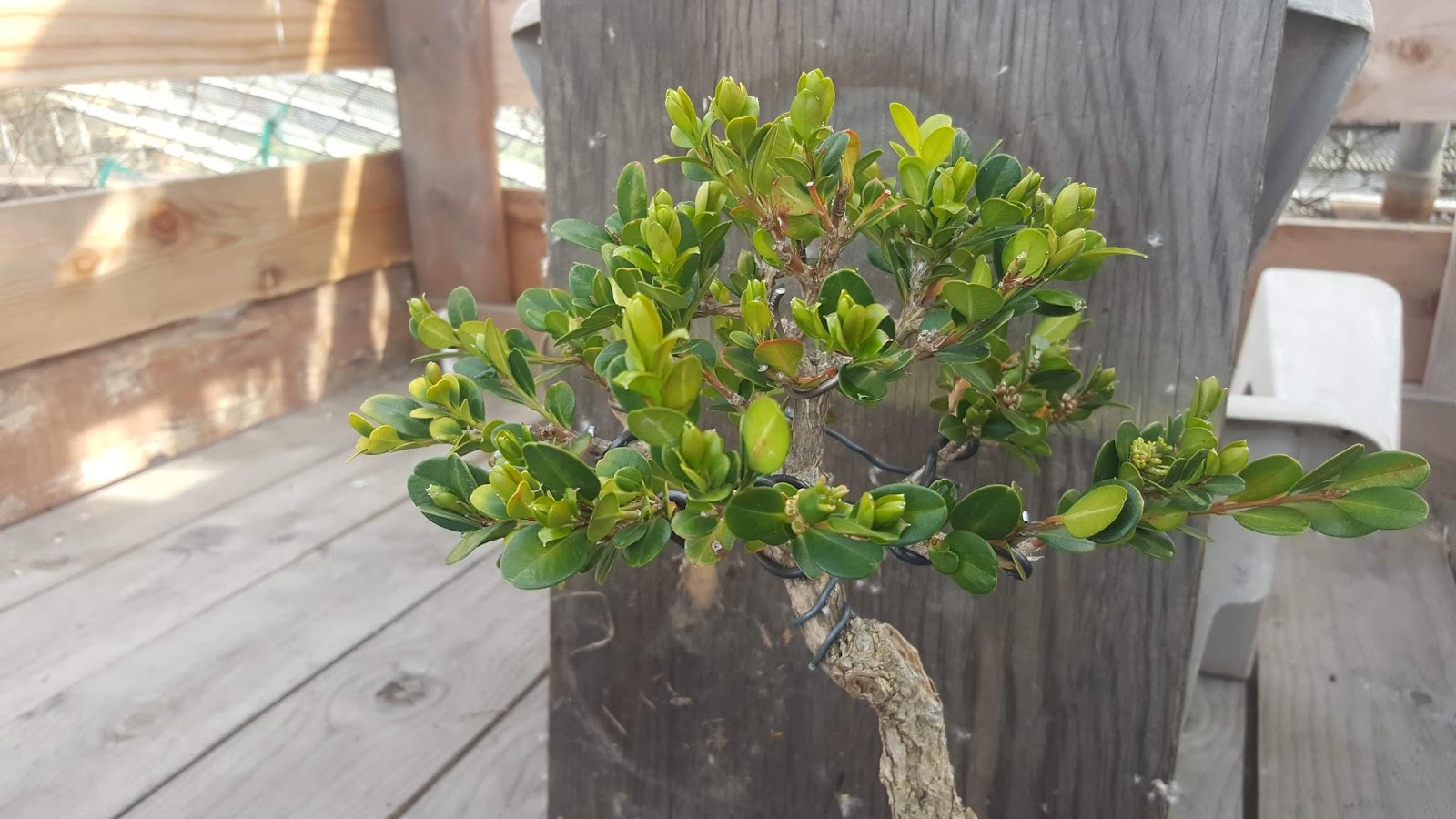
There was this JBW (Japanese boxwood) that had a lot of potential. However, over the
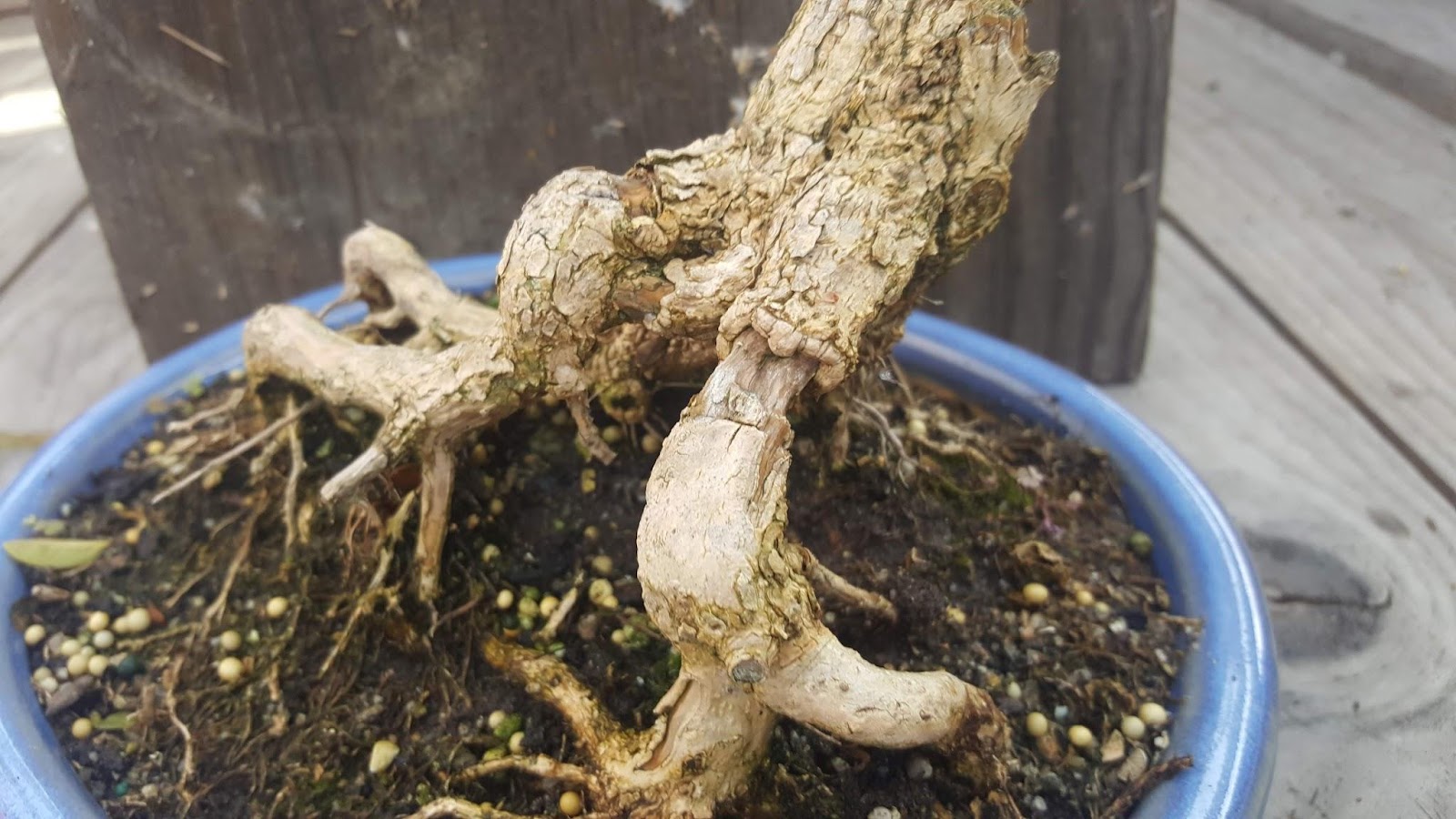
years watering it had washed away the top layer of soil exposing the roots.
I did not mind it so much. It even in my humble opinion looked nice.
It was in a 5-gallon pot. I worked on it for two years getting the roots short enough to pot in a shallow pot. The branches and leaves were looking nice.


Buxus microphylla bonsai


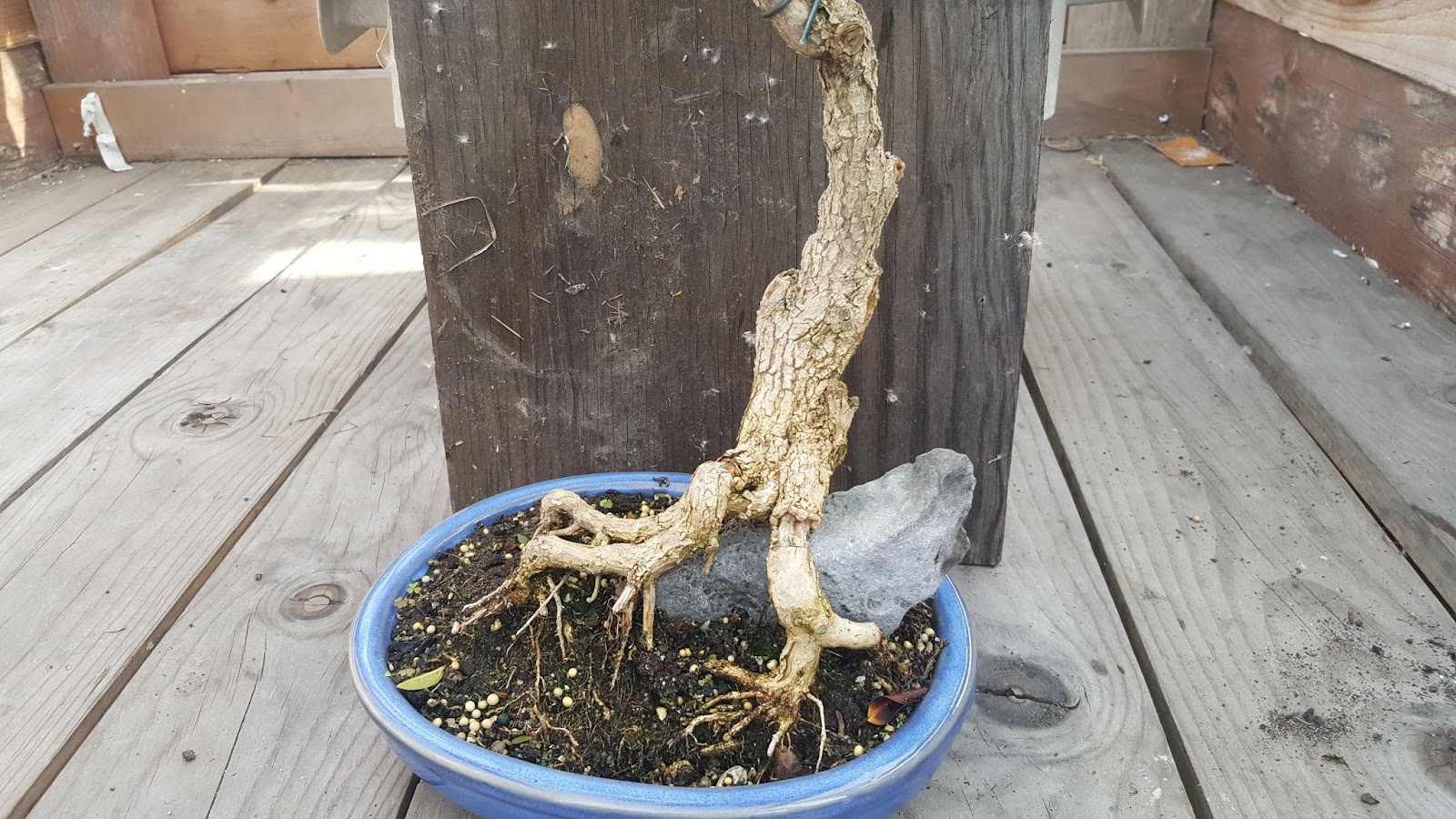
The elephant in the room was the roots:


exposed roots


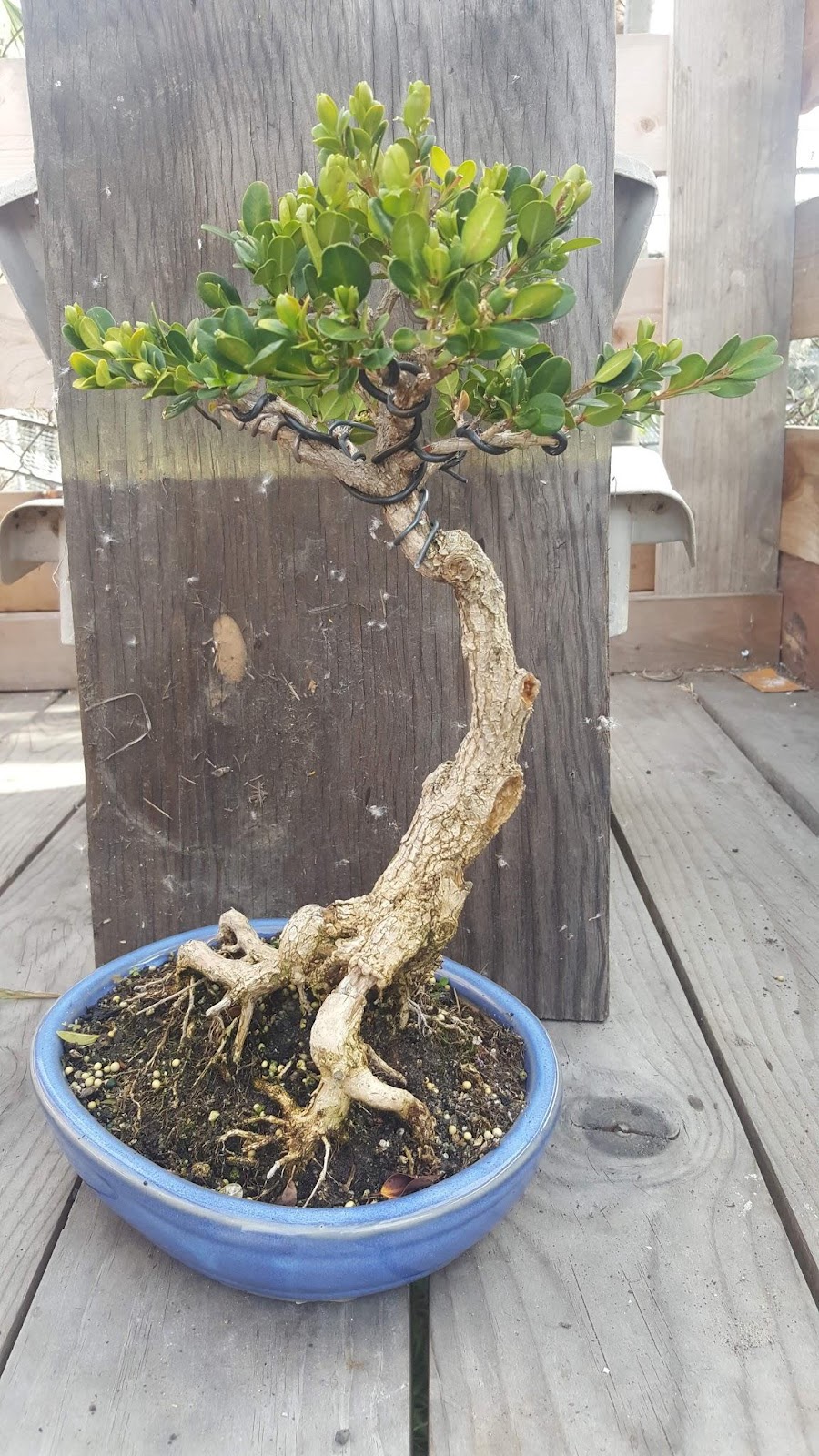
This is what everything looks like together:


Buxus microphylla bonsai exposed root problem
Is this the best tree in the world? Of course not, but I love it.  I always thought that putting
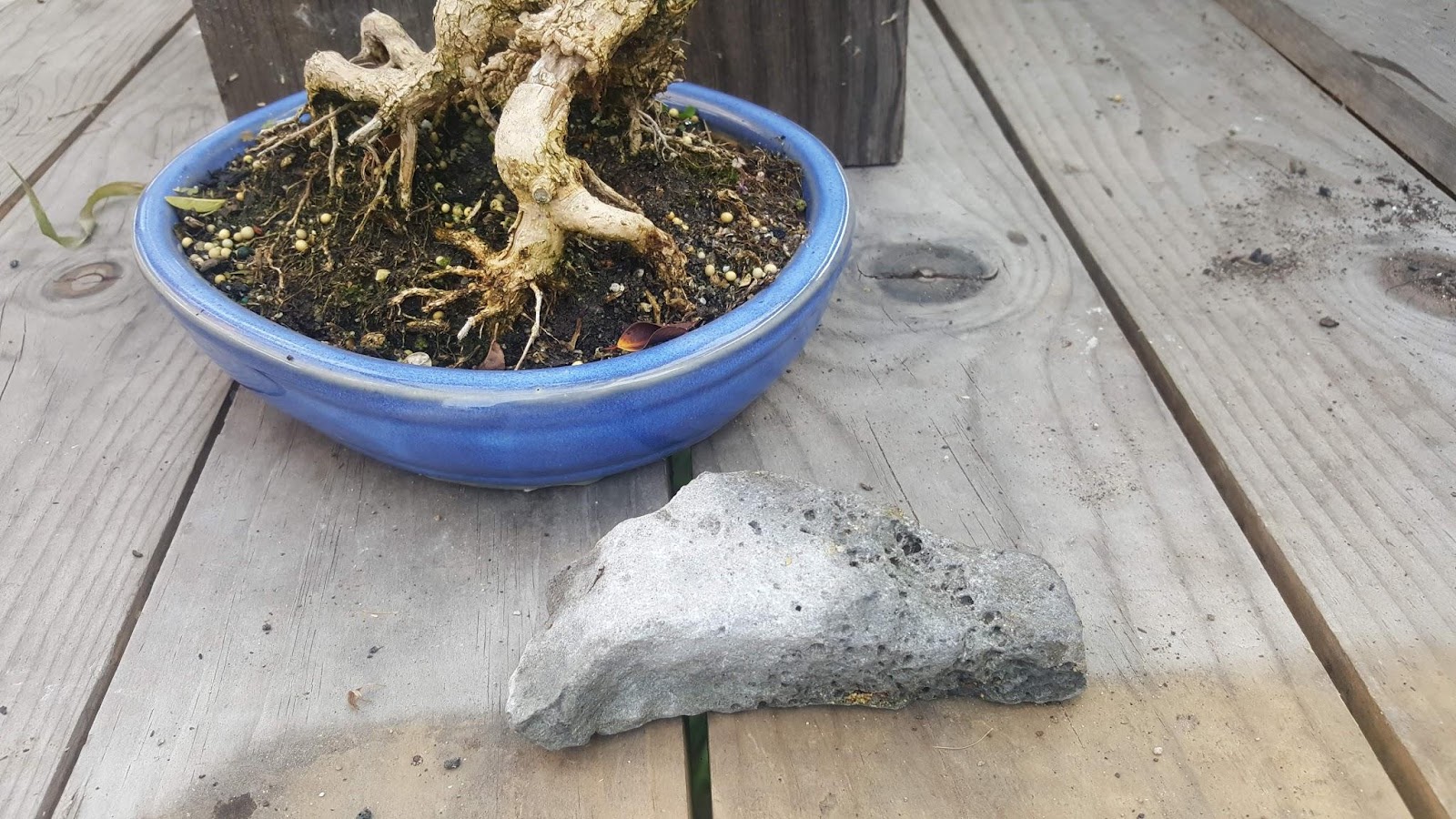
a rock in there would be the best idea. I would need to find a rock that would first, fit in there.
Second, that looked natural and not forced. I stumbled upon this rock in my garden:


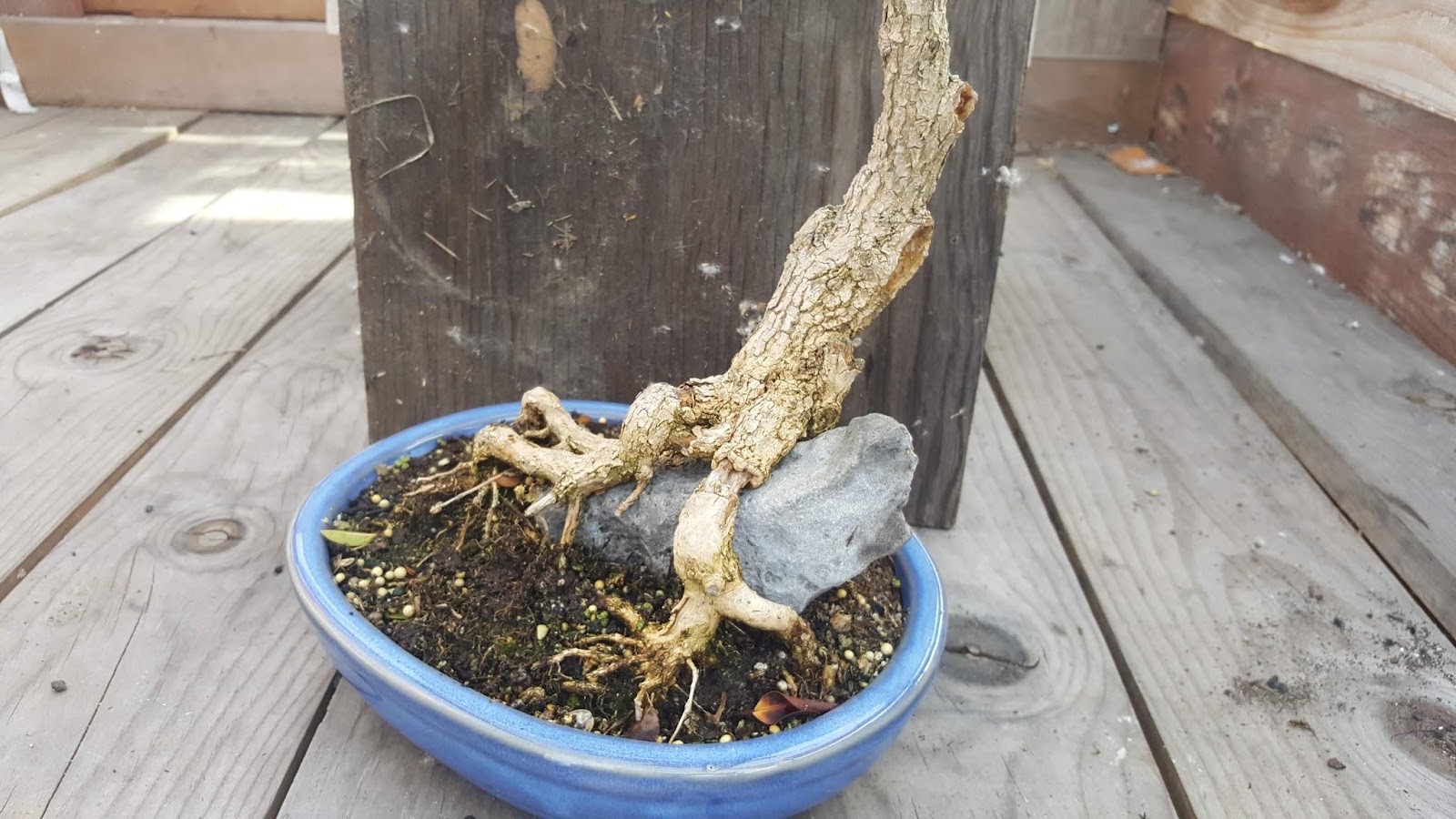
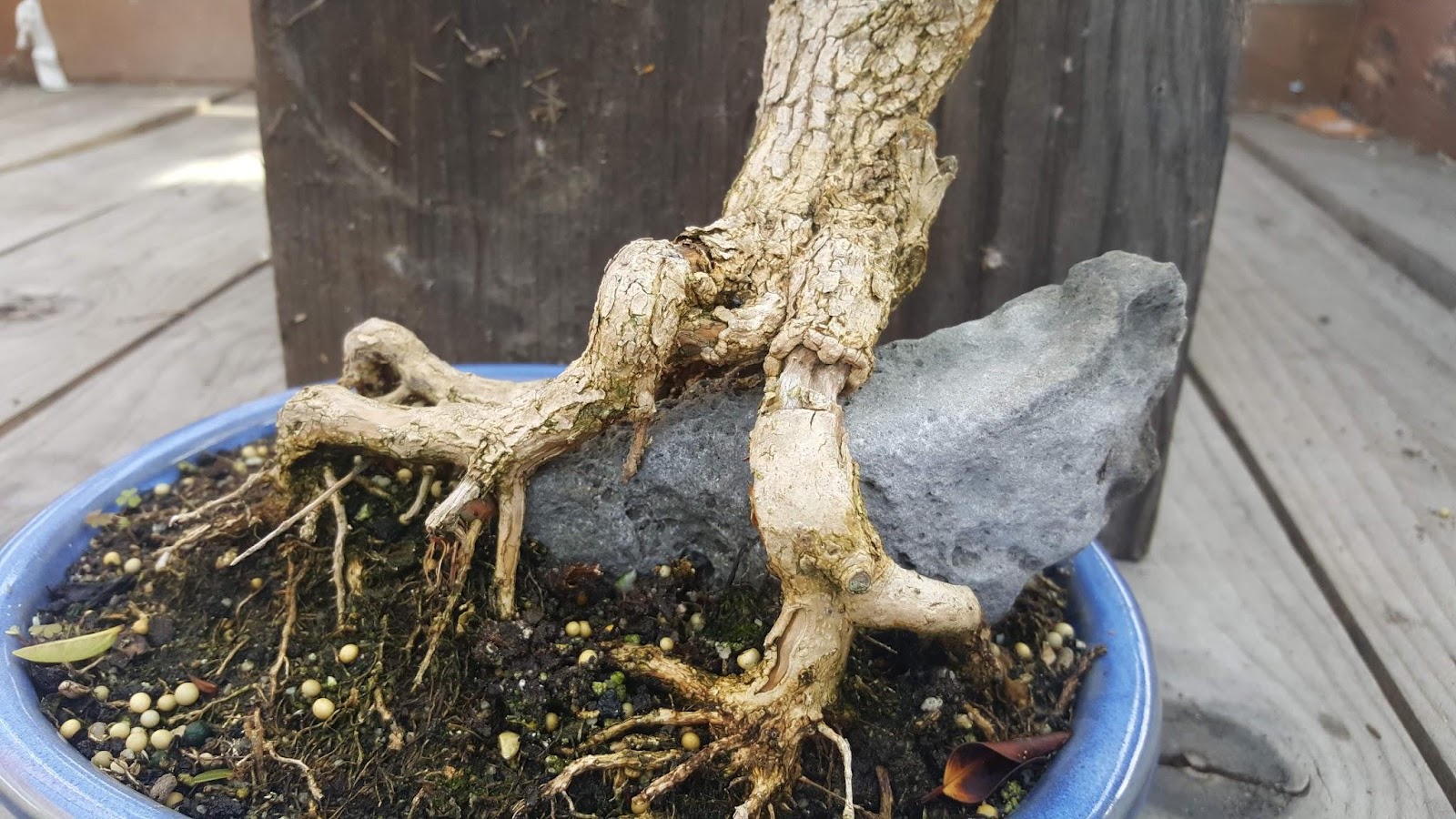
I removed a little bit more dirt. Then I started to wedge the rock in the space between the roots.
I did not want to force it and break the roots.

Buxus microphylla root over rock how to

Buxus microphylla root over rock how to

Buxus microphylla root over rock how to


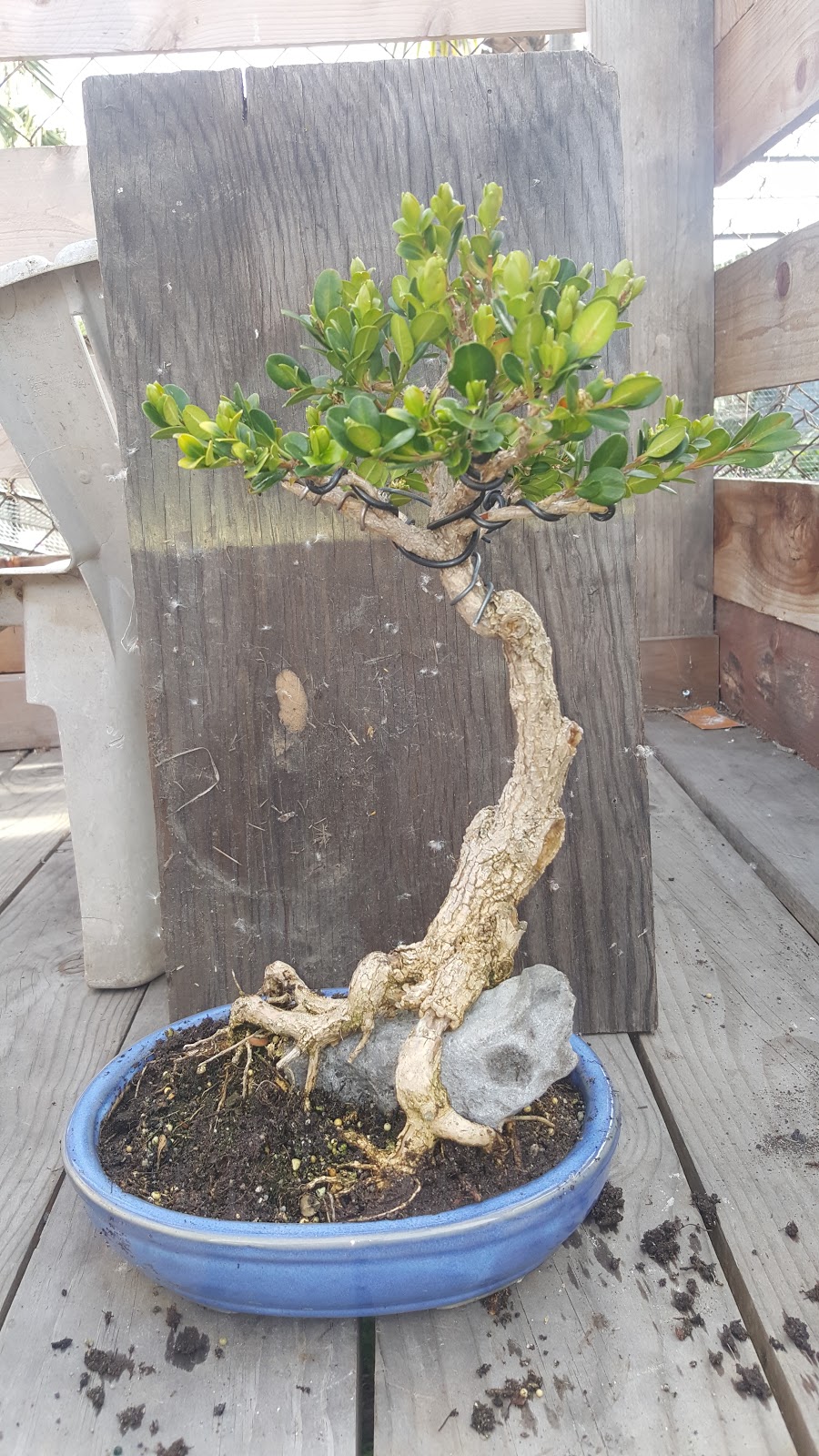
Here is what the whole thing looks like after:

deshojo Buxus microphylla root over rock


It almost looks like they belong together. I would like it to slide a little more in. Ill tap it with this small hammer.

See how the rock curves up mimicking the trunk? That is a very good part of the design.


That's what I did. It came out pretty good if I do say so myself. There is a sense of satisfaction in solving these issues.

Do you have any similar experiences?

Friday, February 23, 2018

Bonsai 101: mallsai, you have to learn to walk before you can run


For those who do not know what mallsai is here is my definition: This is a potted plant, most often woody that has an asian aesthetic that is sold at big box stores or on the side of highways and is labeled as bonsai.


Wow, now that I got that off my chest I feel much better. Thanks for coming folks.

I can’t fool you guys. You came here for some controversy. Well, most of you.

I do not understand why practitioners of the art of bonsai turn their noses at theses trees? Even the word MALLSAI is  used as an unflattering name. So my defense of these bonsai (yes, I dare call them bonsai) is two pronged.

First, the bare roots if you will. The foundations of what a bonsai is. The two things that all bonsai have in common. That is that you get a tree and you put it in a pot. BAM! There You have it.  You might use a piece of slate, plastic pot, a carved rock, it’s all good. Then you stick a plant  in it.

We can all agree that monocot plants are excluded from bonsai. Also, that a potted plant needs to have the appearance of a trunk. Can we all agree that these things are a common denominator in all bonsai across the world? Yes, I am making some big statements here. As I am a nobody in the world of bonsai I have nothing to lose by speaking truth to power and getting all you woke on bonsai or whatever it is people say nowadays.   


I am bringing kanji into the mix. In Japanese this is how you write bonsai:盆栽. It is made of two characters. The first is 盆. That character means tray. I Know because google translate told me so. Google translate also says that 栽 means cultivation. There you have it a tray for cultivation. OK, when you use 栽 as a noun it means plant. So, it means plant in a tray.

Not to make this anymore boring bonsai aesthetics have changed continuously since the time that japan brought penjing from China. Guess what? Bonsai is a living art so it will continue to change. The fact that there is disagreements on aesthetics in the bonsai world is proof of this.

Part two. One man's trash is another man's treasure. Just like lobster, salmon, beef tongue (wait, i am making a point here) these were poor people's food at one point in American history. Now, these babies are expensive delicacies. Why did I bring these things up? Because its proof of changing tastes.

How many of us were introduced to bonsai because of a roadside precombens nana juniper? I am waving my hand in the air. What if that is your comfort level as far as time and money investment? Do those things a bonsai define?

Maybe, just maybe our view on mallsai says something about who we are. Stop, before you scroll down to start trolling let me say this. If you have looked at the eveidence and are satisfied that mallsai are not bonsai. That is ok. I can accept that. However, this is subjective and we have to respect those who enjoy a tiny juniper in a mass produced Chinese ceramic pot with soil that does not drain well and will probably kill it in a month. Or would you rather they killed an 80 year old Japanese black pine because they had no experience keeping bonsai? Cheers.

Friday, September 22, 2017

Bonsai 101, branch ramification and how can I get some

There are many words and phrases used in bonsai. One of the bigger ones is the word ramification. We all know what ramification is, but can we explain it? For all of you that speak a romance language, we can plainly see the root word rama. Which we understand to be a branch. So, ramification is the way branches grow. Booyeah, hit it on the head. Shortest post ever. No, I wish but in bonsai, we like to make things complicated.


In bonsai, we are looking for miniaturization. We are looking to reduce the size of the tree by reducing the size of the trunk, and the branches, and the leaves. How do we do that? Well, here is the basic theory:
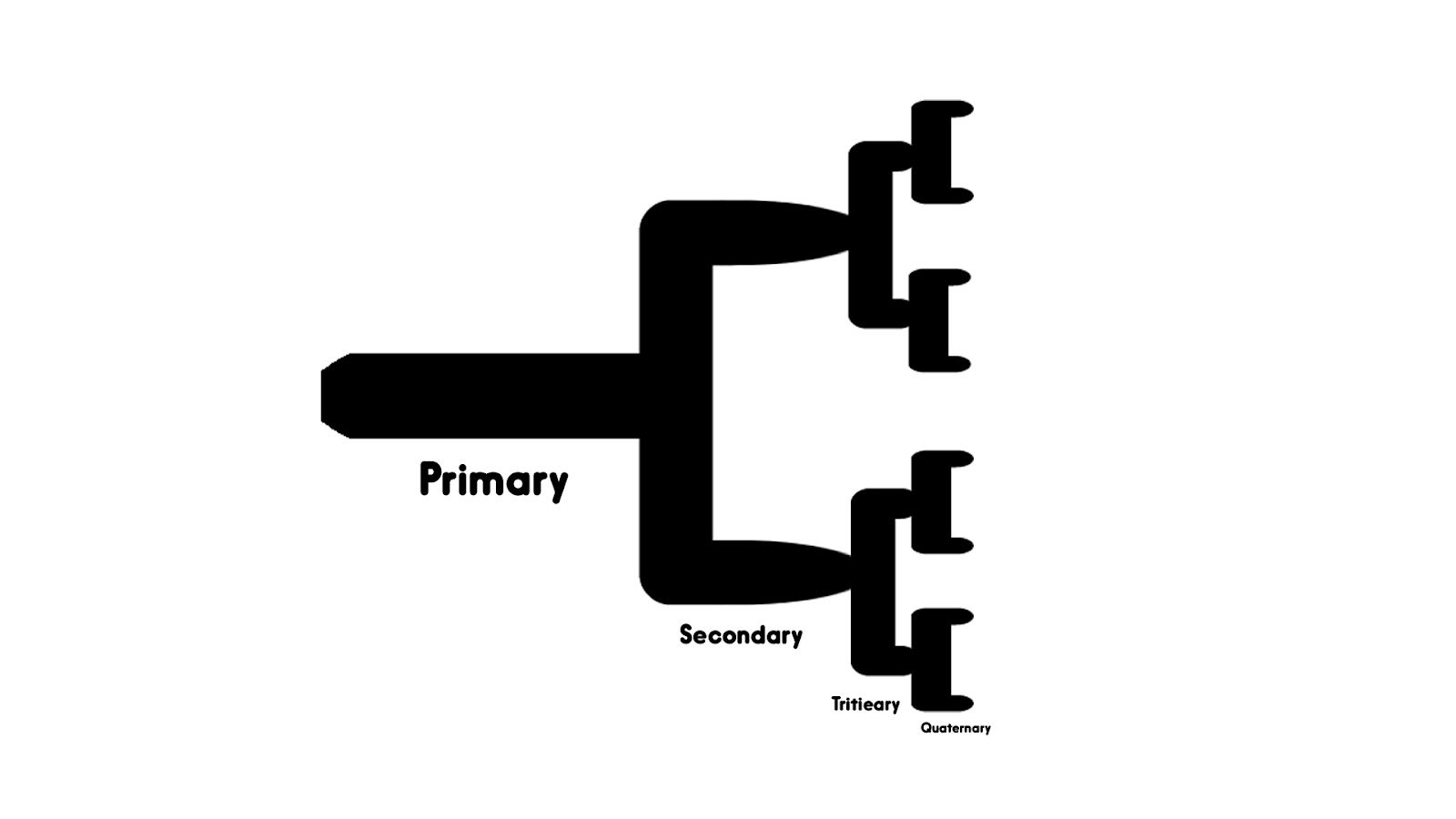
First, we must let branches grow from the trunk. These branches we will call primary branches. These primary branches should grow around the tree in strategic places. The primary branches will become the “skeleton” that will support the rest of the tree’s growth.


Once you have established the primary branches and the tree will grow new branches on the primary branches. These new branches are called secondary branches. Because these branches are younger they should be thinner. A third set of branches will grow on the secondary branches and so on and so forth. These branches will be thinner than the secondary branches. As the branches get thinner the leaf size will also reduce.


The Ideal pattern for branch ramification is to have a pair of new branches grow from the tip of each level of branches. I’ll illustrate below.


This is the ideal situation. Of course, we all know that ideal may not happen consistently in bonsai. There a few things you have to take in mind when you are planning out a plants growth and ramification. Understand your plant species growing habit. Azaleas grow very different from ponderosa pine trees. Learn when and how to prune. This will help develop small compact branches.

You may be asking your self why do the branches have to grow in pairs? Let me show you what happens:
The branch keeps on growing but you only have the one branch. where you could have had 8 branches with small leaves now you have one. There is no ramification.


One last thing is this very interesting article on the growth habit of trees (http://ofbonsai.org/techniques/pruning-trimming-and-pinching/ramification-techniques). There are two types of plants. First, we have plants like palm trees and most pine trees. These have a dominant growth usually at the top. The dominant tip seems to keep growing the strongest and fastest. These type of growth especially among conifers leaves a conical shape on the tree. These trees are monopodial.

Monopodial Pinion Pine

Next, you have trees that grow new branches on lateral buds on different branches. Those trees do not have a dominant growing point, so these trees grow in a much more round shape like many of the deciduous trees. These group of trees is called sympodial.


I think it is important to understand this so we can plan how our trees are going to grow. Cheers.

Friday, September 15, 2017

Understanding the why in everything we do/ are we automatons?


Do you contemplate these questions? Why do I work the job I do? Why do I do the things I do? Why ask why?


Sometimes we do what we do because that's how we have done it for years. Sometimes we do things because it takes too much effort to change, or maybe we do not know any better?


In bonsai, there is this culture of reading things on the internet and taking things at face value. When we are new this is understandable. We do not know anything. As time progresses we hold on to those “rules” and sometimes we do not let go even though maybe we should.


A certain bonsai professional who I like to quote (Ryan Neil) said that we should know why we do what we do. He likes to ask if anybody repots on a schedule. Then he points out that there are only three reasons to repot a tree. One reason is the loss of percolation, another is decomposition and finally, change of style. Those reasons are not dictated by a timetable.


He asks this is because he wants the bonsai community to stop doing things out of sheer tradition. That we should know the horticultural reasons why we do the things we do in bonsai.


“In anything, we do in bonsai there has to be a reason if not it is about us. Right? This is not about us. Bonsai is not about us bonsai is about the tree.” Ryan Neil

Let's dig a little deeper. let's find out what we are really doing to our trees.

That's it. Short and sweet. Something to ponder. Cheers.


Friday, August 25, 2017

Fertilizers and bonsai, the war between organics and inorganics


Growing and fertilizing plants in pots is different than growing and fertilizing plants in the ground. The soil in pots leach out fertilizer with every watering. I think everybody knows that or is aware. That is why we add fertilizer to bonsai.


One day I was reading a gardening article on fertilizer. To my surprise, the article said that plants do not distinguish between molecules of organic and synthetic fertilizers.


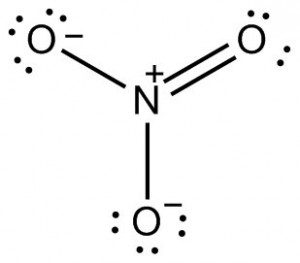
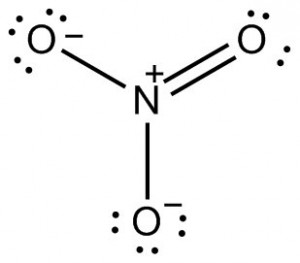
Robert Palvis from gardenmyths.com says, “Let’s look at nitrate molecules in more detail. What is the difference between a nitrate molecule from a synthetic fertilizer and an organic fertilizer? The pictures below show the two molecules.  
                        Synthetic                                   Organic


Can you see the difference??
There is no difference. A nitrate molecule from either source is exactly the same. Most importantly plants can’t tell the difference between a nitrate molecule from a synthetic source and a nitrate molecule from an organic source.
I’ll repeat the last sentence since it is one of the biggest gardening myths. There is absolutely no difference between a nitrate molecule from a synthetic source and a nitrate molecule from an organic source.” (http://www.gardenmyths.com/what-is-organic-fertilizer/)

On another gardening website, it said that the reason a gardener should use organic fertilizer is to build up soil structure. The next thought was, why do I need to build soil structure in a soilless bonsai potting mix? The answer: I do not need to. This benefit of organic fertilizer is completely at odds with using “boon mix” type of soils.  
It seems the negative thing about synthetic fertilizers is that you have to learn how to use them properly because the margin for error is larger compared to organic fertilizer.


However, If you use organic fertilizer are you maximizing the tree's potential? I would say not.


The paradox is that we put a tree in a pot with soil less potting soil. We bend break and shape the tree. We stunt its growth in a small pot. Then we say oh no, manufactured synthetics are one step too far. That seems counterintuitive to me. To me, it seems that synthetic fertilizers give you more control over how much salts you give the tree relative to the concentration of the dosage.  


A quote from sfgate.com, “The nutrients and exact elements available from an organic fertilizer, such as manure or compost, can only be guessed at without laboratory testing. This means you’re giving an inexact application that may or may not meet your plants’ needs. By comparison, applying inorganic fertilizers is simple, because the amount of a given element and the rate of application are known.” (http://homeguides.sfgate.com/inorganic-fertilizer-vs-organic-fertilizer-39528.html)


Organic Fertilizer pic by F@c@ https://www.flickr.com/photos/16705181@N00/20588210/


I looked up the big differences between synthetic and organic fertilizers you may have at home.

Organic- Needs organisms to break down, cold slows down the process, Nutrients are at very low levels. It takes longer to break down the organic fertilizer to stuff your plants can use. This prolongs the life of the fertilizer.


Chemical- the Larger margin for error (unless you use the Walter Pal method for feeding). Fertilizer can be used by plants as soon as it is applied. It is cheaper but not as easy to use as organic fertilizer. It is water soluble so it is leached out very quickly.


I'll give you that by using organic fertilizer you will never burn your trees.  Here is the thing, we who do bonsai create these impossible tasks related to taking care of bonsai. Here is an example. Some people have a calendar on when to prune candles on Japanese black pine. They say that week one you cut off strong shoots, then week two medium strength shoots, then week three prune weak shoots or something similar. My hero Ryan Neil says that is a bunch of nonsense. He says prune all of the candles back at the same time. Why do we like to complicate our lives? Is it not easier to learn how to properly use synthetic fertilizer? Can we learn what to do so that we use the proper amounts? Won't that help our trees and simplify our lives? I think so.


Here are some quotes from Walter Pal on fertilizing bonsai:


I use mainly liquid fertilizer that I get from our cheapest general discount market. In America it would be Walmart... I feed from 20 to 60 times more than the average bonsai grower. From the beginning of April to the middle of October, every ten days everything is fed with liquid fertilizer, using three to four times the suggested dose. All trees are fed equally, whether deciduous, conifers, small, large, repotted, collected or not. This is a span of about 200 days when the trees are being fed. Since the trees are fed three times the normal dose on twenty days in that time, it makes for 60 doses of fertilizer in the growing season. The average bonsai grower feeds maybe three or five times at half the normal dose because 'bonsai trees should not grow'. If you then add two times a year of chicken manure being given to the trees, you can then understand why this schedule is 20 to 60 times more than the average.”


“Too much salt in the substrate is almost impossible if one waters aggressively every day. Even azaleas don't mind my treatment. They thrive very well with very hard water, ordinary baked loam and peat as the substrate and aggressive feeding like all the rest of the trees.”


All in all, if it what works for you is best practice. However, high risk pays high rewards. Cheers.