Showing posts with label theory. Show all posts

Friday, September 22, 2017

Bonsai 101, branch ramification and how can I get some

There are many words and phrases used in bonsai. One of the bigger ones is the word ramification. We all know what ramification is, but can we explain it? For all of you that speak a romance language, we can plainly see the root word rama. Which we understand to be a branch. So, ramification is the way branches grow. Booyeah, hit it on the head. Shortest post ever. No, I wish but in bonsai, we like to make things complicated.


In bonsai, we are looking for miniaturization. We are looking to reduce the size of the tree by reducing the size of the trunk, and the branches, and the leaves. How do we do that? Well, here is the basic theory:
First, we must let branches grow from the trunk. These branches we will call primary branches. These primary branches should grow around the tree in strategic places. The primary branches will become the “skeleton” that will support the rest of the tree’s growth.


Once you have established the primary branches and the tree will grow new branches on the primary branches. These new branches are called secondary branches. Because these branches are younger they should be thinner. A third set of branches will grow on the secondary branches and so on and so forth. These branches will be thinner than the secondary branches. As the branches get thinner the leaf size will also reduce.


The Ideal pattern for branch ramification is to have a pair of new branches grow from the tip of each level of branches. I’ll illustrate below.
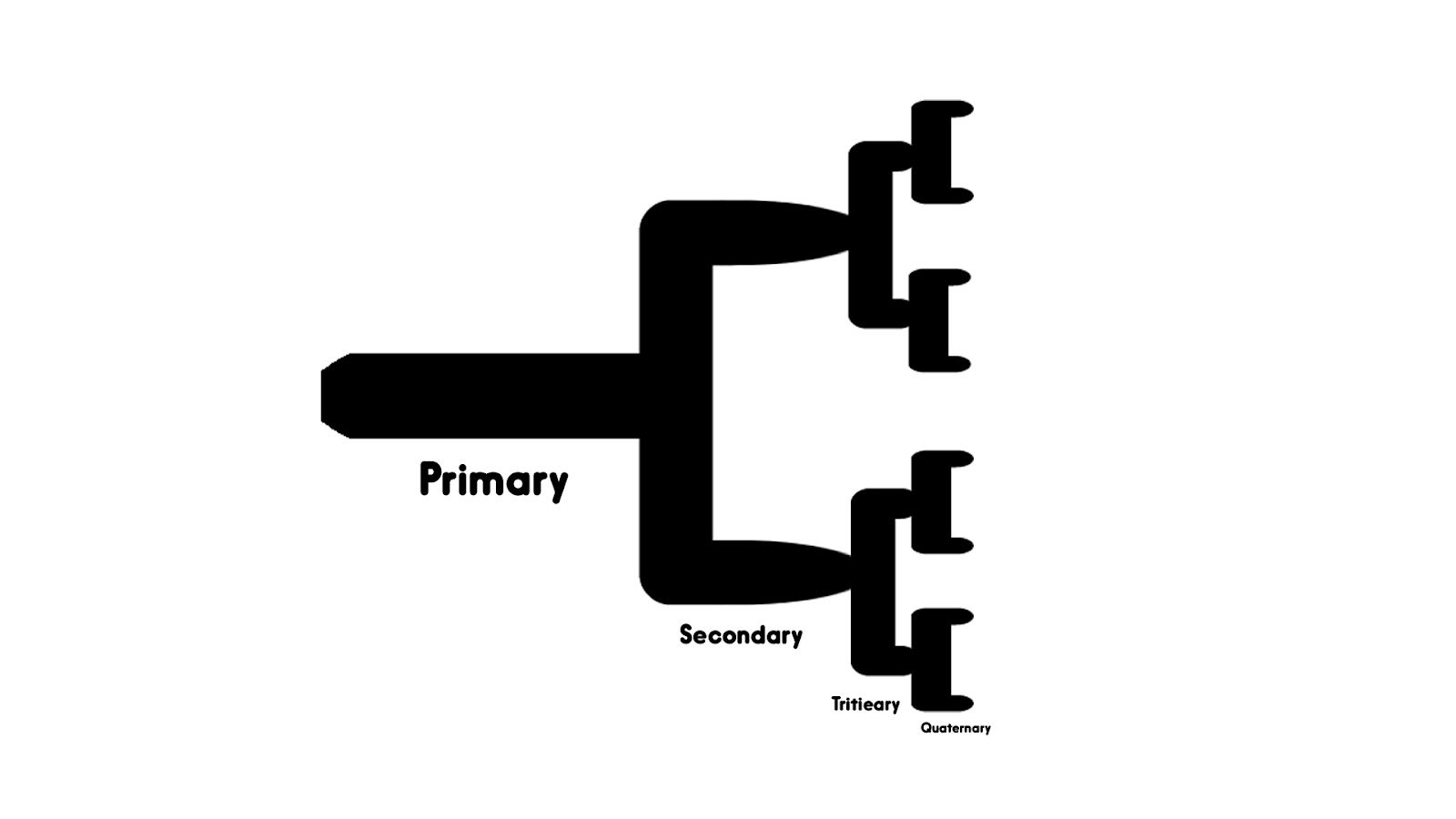

This is the ideal situation. Of course, we all know that ideal may not happen consistently in bonsai. There a few things you have to take in mind when you are planning out a plants growth and ramification. Understand your plant species growing habit. Azaleas grow very different from ponderosa pine trees. Learn when and how to prune. This will help develop small compact branches.

You may be asking your self why do the branches have to grow in pairs? Let me show you what happens:
The branch keeps on growing but you only have the one branch. where you could have had 8 branches with small leaves now you have one. There is no ramification.


One last thing is this very interesting article on the growth habit of trees (http://ofbonsai.org/techniques/pruning-trimming-and-pinching/ramification-techniques). There are two types of plants. First, we have plants like palm trees and most pine trees. These have a dominant growth usually at the top. The dominant tip seems to keep growing the strongest and fastest. These type of growth especially among conifers leaves a conical shape on the tree. These trees are monopodial.

Monopodial Pinion Pine

Next, you have trees that grow new branches on lateral buds on different branches. Those trees do not have a dominant growing point, so these trees grow in a much more round shape like many of the deciduous trees. These group of trees is called sympodial.


I think it is important to understand this so we can plan how our trees are going to grow. Cheers.

Wednesday, August 24, 2016

Bonsai, it's the sushi of the horticultural world


I needed a picture for this post, so I chose this

It's time for one of my rants. Subject: Suhi. No, Not really. It's about bonsai. In fact, it is about the evolution of bonsai, and international bonsai.  


A while ago I watched a Begin Japonology episode about sushi. Sushi at first was fermented fish preserved in rice. This was something similar to what had been done in China. Sushi was an import. It slowly changed according to prevailing circumstances. At first sushi was a food only eaten in Japan. Sushi eventually made it to other countries. Some of these countries started making sushi with local ingredients. A good example is the famous California roll. The use of local ingredients has created in some a desire to eat/ learn about “authentic” sushi.


Is this sounding familiar? The parallels to bonsai is very uncanny. One could formulate many reasons as to why this is, but that is a post for a future date.


I was watching NHK last weekend. The subject was sushi. The last segment of the show was about the evolution of sushi in other parts of the world. The consensus was that international varieties of sushi should be encouraged. Sushi should be an inclusive food. Also, that sushi from other parts of the world does not detract from what sushi is in Japan. In japan you can get conveyer belt sushi all the way up to sushi made by Jiro.


You have already talked about what a bonsai should look like before Ivan. I know, I have. However, This is a different perspective. Sushi and bonsai have many similarities. Like any metaphor they are not identical. Yet, it is interesting to see how two distinctly Japanese things that are popular around the world  are perceived by the very people who make them. The differences in how each group embraces the evolution of the two art forms is remarkable. Why is there so much push back from the bonsai people in regards to evolving bonsai design. Why is evolving sushi trends more palatable ;)?

Do we who love bonsai love to argue? There are many points of contention in the world of bonsai. Why is that so?  Are people who are attracted to bonsai by nature grumpy people? I do not think so. If that was the case every bonsai club in the world would be composed of one person. Maybe its that bonsai attracts people who like to make things “perfectly”. These people want to make the best bonsai possible. In their quest for the perfect tree they become very meticulous. Or not. Cheers.    

Thursday, April 21, 2016

Artistic elements in bonsai, the Focal point

Focal points are wonderful tools. They grab the attention of the viewer. In trees focal points for the most part are in Mr. Ryan Neil’s words special features. Special features are those parts of a tree that you want to highlight. Some trees have amazing flowers. Special features can be jin and shari. Also, fruits and leaves can be special features. Focal points can be the nebari (roots on the soil surface), or the way the trunk twists. Think to yourself what is the most interesting part of the tree?

Since your focal point grabs attention quickly it carries a lot of weight. On a post about balance I will touch on focal point in the overall picture. Cheers.


the rock is an amazing focal point
All that Shari brings the eyes right to the trunk
You can't help looking at the tick twisted part of the trunk
ficus microcarpa
The aerial roots are a good focal points

Is there a focal point here?

Wednesday, April 20, 2016

Artistic aesthetic elements in bonsai, Space

It's everywhere unless we are taking it up. Space is another element in art.  There are two parts to space. They are positive space and negative space. Positive space is the space that the tree takes up. This includes trunk, branches, and foliage. Negative space is the space in between the positive space. In other words the empty space.


Understanding negative space is critical to good bonsai design. Even though negative space is empty space it plays an important role in where we place the parts of a tree.


Look athe the branches from left to right. It is filled with negative space. However, some spaces are bigger than others. The left side the negative spaces are more and they are smaller. The right side has bigger negative space. As your eyes move along the tree it will tend to pause at those bigger spaces. I don’t really want that to happen with this tree. So I will have to break up the negative space.


Can you see the difference?


There is also negative space that surrounds the tree. I personally prefer when the negative space surrounding a branch touches the trunk. That is just my preference. Here are two distinct ways to use negative space.  


Space, its positive or its negative. Use negative space to support your positive space. Lots of negative space around an object makes it look alone. Less negative space creates more tension. Cheers.

Monday, April 18, 2016

Artistic Aesthetic elements cont..., Shapes and forms

Shapes are two dimensional and geometric. When you draw a circle, square, or triangle you are drawing a shape. Forms are three dimensional and geometric. These include cylinders, pyramids, and cones. I would say that the most prevailing shape in bonsai is conical.


conical


Semi spherical
Spherical form


Besides the obvious silhouette made by a form they are important in that they can add to motion. In sculpting rhythm is important. Adding forms to sculpture gives rhythm. Repetition of shapes in varying sizes creates rhythm.


The trunk and foliage are two different cones

Rhythmic design

Shapes and forms are easier to understand than some other elements. The key is to use them to guide the eye. Cheers.


Saturday, April 16, 2016

Artistic aesthetic elements in bonsai, or making bonsai pretty

It might be presumptuous of me to tell other people how to fix aesthetic flaws in their bonsai. After all I am a novice. Like I have said before, bonsai is a living sculpture. Sculptures are art, and I know something about art. I will explain the fundamentals of art theory and relate them do bonsai aesthetics. Yes these are my opinions, you are welcome to disagree. I already stated that bonsai is art (http://bonsai-misadventures.blogspot.com/2016/03/bonsai-what-should-they-look-like.html). Now I will delve deeper.


I will focus on the following elements: line, shape, form, space, color, texture, and balance. So as not to bore you I will make separate posts for each element. We will begin with line. Lines are everywhere. Where dark and light meet you have a line. Where two colors meet you have a line. Trunks branches and leaves make lines. The silhouette of a tree makes a line. Lines are ever so important in art.  

Chokkan
Lines guide the eye

The lines in your bonsai will show the eyes what direction to move. The most interesting lines are the ones that vary in thickness and direction. Some people say that a bonsai needs a tapering trunk to suggest age. I say, maybe. However a tapering trunk is a line that varies in thickness and that my friends is very pleasing to the eye. A wide base and thin apex gives the illusion of a vanishing point. The more pronounced the further the perceived distance.

The trunk is a line of varying width
Some lines are suggested. Like under and above a pad of foliage. I love white pine. The reason is that the needles are little lines. They vary in value (shade) and give the tree texture.


Pinus parviflora
suggested lines under and above the foliage
Lines tell the viewer what to feel. Vertical lines are rigid and stern. Horizontal lines are calm. Diagonal lines are action and tense. 


Take the formal upright style. Most of the lines are horizontal. In the center there is the main line which is vertical. These lines make the formal upright style seem traditional and comforting.  
Vertical and horizontal lines
I may offend some readers by saying that these horizontal and vertical lines are boring. What is keeping this style from making the trees look like topiary is the silhouette. The silhouette is composed of two suggested lines that are diagonal. Don't misunderstand me. Chokkan or formal upright is a very difficult style to make.
Suggested diagonal lines
The windswept style can be very dynamic. I saw this chinese elm at the National Bonsai and Penjing Museum. I was awe stricken. Not only are the lines diagonal, but they move in one direction and then go the opposite way. There is a lot of movement for the eye to perceive.

Diagonal lines

Lines, in road ways or art, they take us on a journey. Cheers.